
In short
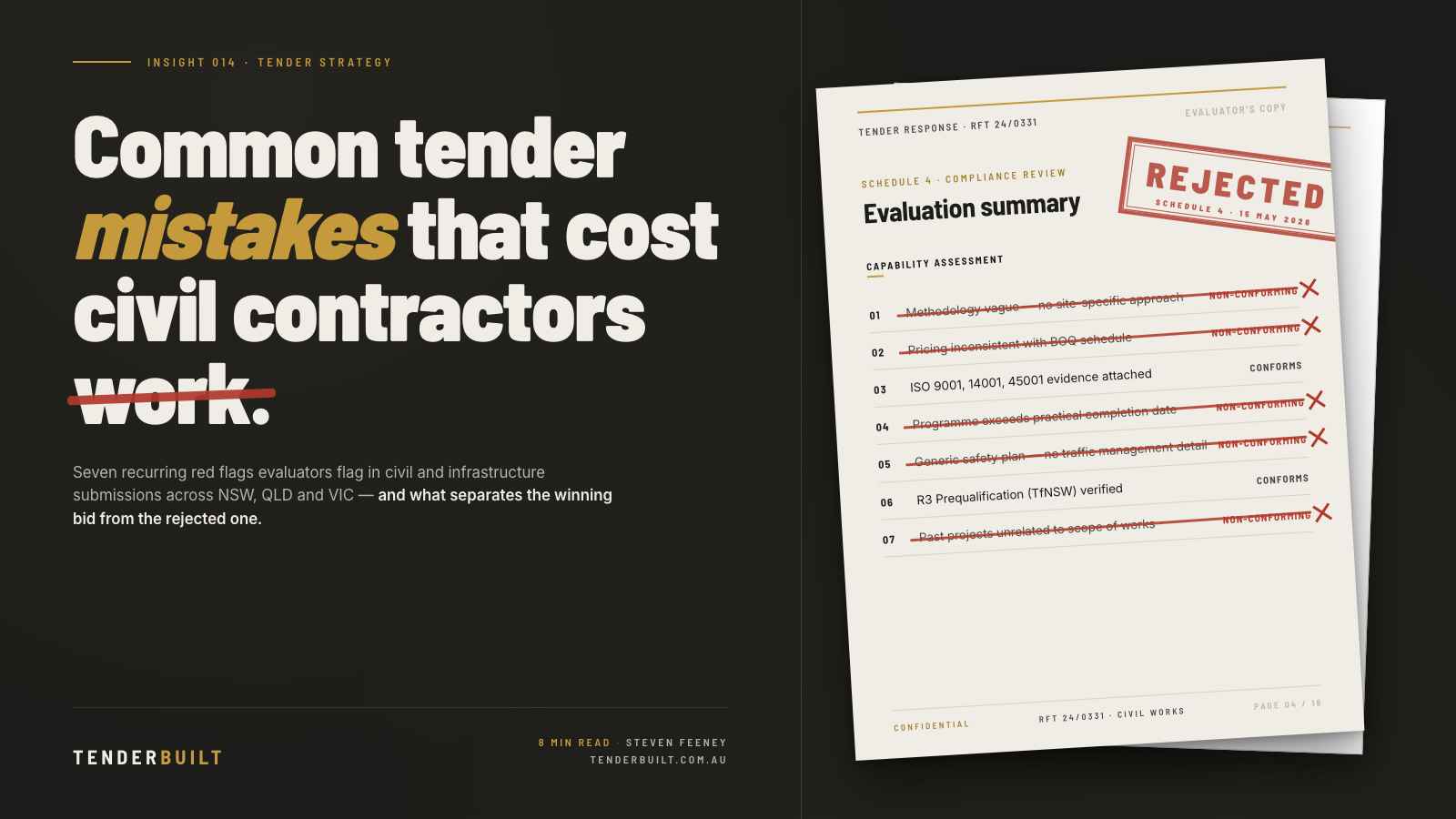
Most civil tenders are lost on process, not price: late lodgement, missing returnables, expired insurance and unsigned forms disqualify before evaluation; generic methodology, dated projects, mismatched CVs and WHS plans without site specifics lose the marks that remain. All twelve mistakes are fixable inside a tender cycle with a sign-off checklist, a content library and a go/no-go gate.
Most civil construction tenders are not lost on price. They are lost on process — compliance breaches, generic methodology, weak experience presentation, missing WHS evidence, and pricing errors that disqualify capable contractors before evaluators ever assess the substance of the response. The encouraging news is that almost all of these failure modes are fixable, often inside a single tender cycle.
This article breaks down the 12 mistakes most commonly costing civil SMEs work in NSW, Queensland, and Victoria — what they look like to an evaluator, why they cost marks, and the specific fixes that close each gap. It is a companion to our pillar guide on writing a winning civil construction tender in Australia, narrowed to the diagnostic question every losing bidder asks after a debrief: where did we lose marks, and what do we change next time?
The economics make this analysis worth doing. Industry estimates suggest a typical $50K–$2M civil tender consumes 40–80 hours of internal preparation time, with external bid writer fees ranging from $5,000 for simple submissions to over $40,000 for major project bids.[1] Procore Australia cites a 5:1 hit ratio as a common construction tendering benchmark — one win for every five tenders.[2] If you can lift your win rate from one-in-five to one-in-four by fixing the mistakes below, the economics shift significantly.
1. The real cost of losing tenders
Losing a tender is not free. Every unsuccessful bid carries the full cost of preparation — the estimating hours, the internal coordination, the writing time, the management review — without any compensating revenue. Industry estimates put the average tender preparation cost across Australian sectors at around $47,000 per response, against a typical win rate of about 20%, implying roughly $188,000 in bid costs per win at average performance.[3] For civil SMEs without professional support, win rates often sit in the 10–20% range, increasing the cost-per-win further.
The compounding effect matters more than the per-tender number. As BidWrite, Australia’s largest bid consultancy, notes, “repeated losses represent pointless effort, and this has increasingly negative impacts on the morale of the work-winning staff involved. Externally, half-hearted, rushed or long-shot submissions create poor impressions with the very people you are trying to impress.”[4] A pattern of losses signals to procurement officers that you are not a credible competitor — which makes future shortlisting harder, even on tenders you should win.
The mistakes below are organised by category, in roughly the order an evaluator encounters them: compliance and threshold checks first, then substantive evaluation of methodology, experience, WHS, price, and presentation. The order matters because mistakes in the first category are typically fatal — they end the evaluation before substance is assessed.
2. Compliance failures — the disqualifiers
Compliance failures are responsible for the majority of pre-evaluation tender rejections. They are also the easiest category to eliminate, because they are mechanical rather than judgement-based.
Mistake 1 — Late submission
The portal clock governs. AusTender, Buy NSW Tenders, QTenders, Buying for Victoria, and council platforms like VendorPanel all reject submissions received after the closing time. Your computer clock, your email server clock, and your watch are all irrelevant. Rule of thumb: lodge at least 24 hours before close, and confirm the upload succeeded.
Mistake 2 — Missing returnable schedules
Every Form of Tender, Schedule of Rates, Schedule of Personnel, Schedule of Plant, Schedule of Subcontractors, Schedule of Insurances, and Statement of Compliance must be returned, completed, and signed where required. A missing returnable can be treated as a non-conforming bid — typically disqualifying.
Mistake 3 — Format breaches
Page limits, font sizes, file naming conventions, and file size limits are not suggestions. Where the Conditions of Tendering specify a 20-page methodology, a 22-page methodology can be discarded back to 20 pages with the additional content treated as non-conforming.
Mistake 4 — Expired insurance certificates and missing signatures
Insurance certificates of currency, certificates of incorporation, and licences must be current at the date of submission. Certificates that expired the week before close are a frequent cause of disqualification. Likewise, an unsigned Form of Tender is treated as not lodged.
3. Methodology mistakes — generic, untethered, incomplete
Mistake 5 — Boilerplate methodology
Generic methodology that could apply to any project is the single most common reason capable contractors lose marks on a substantive evaluation. The classic tells: no reference to the specific site, no reference to the specific Austroads or state road authority specifications cited in the brief, and language lifted directly from a previous tender for a different project. Evaluators read tenders for a living. They spot copy-paste methodology in seconds.
The fix is to anchor every methodology section to a specific feature of this project. Reference the actual chainage limits in the construction sequence. Name the actual TGS plan reference. Identify the actual hold points from the project ITP. Where the specification calls up Austroads Guide to Pavement Technology Part 8 for lot-by-lot QA, your methodology should explain the lot definition you are applying and the sub-lot acceptance approach for that specific pavement section.
Mistake 6 — No quality hold points or ITP reference
A civil methodology without explicit hold points and a referenced Inspection and Test Plan is a methodology that does not understand Austroads QA. Evaluators expect to see hold points at logical control gates — typically subgrade preparation sign-off, sub-base lot release, base course lot release, prime/seal acceptance — each tied to specific test methods and acceptance criteria.
Mistake 7 — Missing or unreconciled programme
The construction programme is a methodology document, not a separate exhibit. A Gantt chart that does not reconcile with the labour and plant histogram, or that shows critical path activities your methodology does not describe, undermines the credibility of the entire response. A programme that omits demobilisation, defects walk, or hand-back signals an incomplete understanding of the contract.
4. Experience and capability mistakes
Mistake 8 — Irrelevant or dated past projects
Evaluators score relevant experience on scope match, scale match, recency, and client type. Past projects more than five years old are routinely treated as not relevant. A $5 million highway project is not relevant experience for an $800,000 council road job — too large, different procurement context. Likewise a $200,000 private driveway is not relevant for a council contract — wrong client type.
The sweet spot is three to five projects in the past five years that are similar to or slightly larger than the tender at hand, with a similar client type (council to council, or state agency to state agency).
Mistake 9 — Key personnel CVs that don’t match the project
If the tender requires a Project Manager with five years’ experience delivering council civil maintenance contracts, putting forward a Project Manager whose recent experience is residential subdivision earthworks is a marking penalty even if the candidate is technically capable. CVs must be tailored to highlight the specific experience the tender requires, with project examples that align to the scope.
Mistake 10 — Missing or weak referees
Three referees who can speak to your delivery on similar work are worth more than a long list of generic referees. A weak or unreachable referee can sink an otherwise strong submission. Confirm referee consent before you list anyone, and brief them on the tender so they can speak to the specific scope.
5. WHS, quality, and environmental gaps
Construction is one of Australia’s higher-risk industries. Safe Work Australia’s Key Work Health and Safety Statistics Australia 2025 records 37 worker fatalities in construction in 2024 — 20% of all worker fatalities — and the construction sector accounts for 12% of all serious workers’ compensation claims.[5] Evaluators take WHS evidence seriously because principal contractors carry meaningful WHS duties under the model Work Health and Safety legislation.
Mistake 11 — Generic WHS plans without project specifics
A WHS Management Plan that could apply to any project is treated by evaluators as evidence that no project-specific WHS thinking has occurred. Site-specific risks must be identified — for civil works that typically means traffic management, services strikes, falls from height on plant, working with mobile plant near workers on foot, and excavation safety. A generic SWMS attached to the tender as a single PDF, with no link to the specific construction sequence, undermines the methodology section as well.
Missing certifications
The three ISO certifications expected on most civil tenders — AS/NZS ISO 9001:2015 Quality, AS/NZS ISO 45001:2018 OHS, and AS/NZS ISO 14001:2015 Environmental — must be issued by a JAS-ANZ accredited certification body and current at the date of tender. NSW SCM0256 and SCM1461 prequalification schemes both require ISO 9001 and ISO 45001 as a minimum, with ISO 14001 added at higher tiers.[6]
No demonstrated safety performance
Evaluators expect to see Lost Time Injury Frequency Rate (LTIFR) data for the past three years, with notable incidents and the corrective action taken. A tender response that says only “we have a strong safety record” without numbers signals that the data is either unmeasured or unflattering.
6. Pricing mistakes
Pricing errors break tenders in three ways: arithmetic mistakes that trigger evaluation panel scepticism, missing items that produce a non-conforming bid, and unrealistic pricing — too low or too high — that disqualifies on value-for-money grounds.
Arithmetic and completeness errors
Schedule of Rates totals that do not reconcile with the Form of Tender total, BOQ items priced at zero where the brief clearly contemplates work, and missing subcontractor pricing where the methodology references a subcontractor scope. These are mechanical errors that a final review should catch — and frequently does not, when the same person who built the price is also the only one reviewing it.
Unrealistic pricing
Australia does not have a formal abnormally low tender (ALT) investigation regime, but principals routinely seek clarification on bids that sit significantly below the principal’s estimate or below the average of conforming bids. The Commonwealth Procurement Rules updated in November 2025 explicitly require ethical conduct and reasonable enquiries into ability to deliver as part of the value-for-money assessment.[7] Tenderers should be able to substantiate any pricing that looks aggressive — not because the principal is hostile, but because principals who award contracts to unsustainable bids are exposed to delivery risk and audit scrutiny.
No contingency or risk allowance
Civil works tenders priced without a visible contingency or risk allowance often signal naïveté to evaluators. Typical contingency on lump sum civil work sits in the 3–10% range depending on design maturity and ground risk. Design and construct work under AS 4902 attracts a higher contingency because the contractor carries design risk. For a deeper treatment, see our pricing strategies for government tenders guide.
7. Presentation and writing mistakes
Tenders are evaluated by humans, often working through a stack of submissions on a deadline. Presentation matters more than tenderers like to admit.
- Typos and grammatical errors — flag a careless attitude to detail and undermine claims of quality discipline.
- Inconsistent terminology — switching between “Project Manager” and “Site Manager” for the same role, or between “Superintendent” and “Principal’s Representative” for the same contract role, signals that multiple authors have not been edited together.
- Copy-paste errors leaving previous client names visible — a tender response that mentions the wrong council in a methodology section is sometimes treated as fatal regardless of how strong the rest of the response is.
- Walls of text without structure — paragraphs that run to a full page with no sub-headings, no bullets, and no diagrams force the evaluator to do the structuring work that the writer should have done.
- No executive summary — a strong executive summary at the front of the methodology earns marks by giving the evaluator an organised view of your win themes before they engage with the detail.
- Ignoring the evaluators’ language — if the brief uses the term “construction methodology” use that term, not “construction approach” or “delivery methodology.” Mirroring the evaluator’s language signals close reading and helps with scoring spreadsheets.
8. Strategic mistakes
The mistakes above are tactical — fixable inside a single tender. The strategic mistakes are systemic, and they cost more in aggregate than any individual response error.
- Bidding on inappropriate work — projects outside your geography, outside your contract value sweet spot, or in a discipline where you do not have demonstrable experience. A formal go/no-go process is the single most effective discipline for solving this; see our companion article on the go/no-go decision.
- No win themes or differentiators — every competitive tender should articulate two or three reasons the principal should choose your bid over the alternatives. Without explicit win themes, your response is a checklist of compliance items rather than a competitive proposal.
- Treating tender writing as a transaction — same template, same boilerplate, same approach for every tender. Tenders are strategic communications: each should be tailored to the specific principal, the specific scope, and the specific competitive position.
9. The most expensive mistake — disqualification on technicalities
The single most expensive category of tender mistake is the technical disqualification — a non-conformance that ends evaluation before substance is considered. Common examples:
- Late lodgement, including by a single minute on the portal clock.
- Missing certified copy of public liability insurance, or expired certificate.
- Failure to sign the Form of Tender.
- Uploading the wrong file version (a draft methodology saved over the final, or a previous tender’s BOQ).
- Missing mandatory criteria — for example, no Aboriginal Participation Plan on a NSW contract above $7.5 million.[8]
The fix. Build a tender lodgement checklist that is signed off by two people 24 hours before close, not on close day. The second sign-off is non-negotiable: the writer’s eyes have been on the document for too long to catch the small errors. Five minutes of cross-check by an uninvolved senior person will catch most disqualification triggers.
10. Building an internal tender review process
The proposal-management discipline imported from the Shipley and APMP frameworks recognises four review gates, named by colour. Australian bid consultancy Madrigal describes the Red Team as “the most important, the most critical and comprehensive of all the reviews.”[9]
| Review | Timing | Purpose |
|---|---|---|
| Pink Team | ~25% through tender period | Strategy and outline; confirm win themes and structural fit to evaluation criteria |
| Red Team | Draft stage | Independent review predicting how the customer will score; ideally someone not on the writing team |
| Green Team | Late cycle | Pricing review once direct cost inputs are stable |
| Gold Team | Pre-submission | Executive sign-off and final approval |
Source: Shipley Associates and APMP proposal review framework, adapted for Australian civil construction tendering.
For SME tenderers, the four-team model usually compresses to two reviews: a combined Pink-and-Red review at draft stage, and a combined Green-and-Gold review at the final pricing and approval stage. Even a one-hour fresh-eye review by a senior person not involved in writing will consistently catch errors the writing team has stopped seeing.
11. The fix-it framework — quick wins, structural fixes, capability building
The mistakes above are not a counsel of despair. They are a diagnostic checklist. Most can be addressed in three time horizons.
Quick wins (one week or less)
- Build a tender lodgement compliance checklist with mandatory dual sign-off 24 hours before close.
- Standardise a single tender response template with consistent terminology, font, and section structure.
- Refresh insurance certificates and licences so they are not within 30 days of expiry on any pending tender.
- Confirm three referees who can speak to recent similar work, with their consent on file.
Structural fixes (one to three months)
- Build a tender content library of methodology language, project examples, key personnel CVs, WHS plans, and environmental management plans, organised so they can be tailored quickly per tender. As BidWrite notes, a well-constructed library reduces drafting time and increases the time available for strategy and customisation.[10]
- Initiate the ISO 9001, ISO 14001, and ISO 45001 certification process if not already in place.
- Standardise a methodology framework with site-specific overlay for each tender, so generic methodology text is replaced by anchored, project-specific language by default.
Capability building (six to twelve months)
- Implement a formal go/no-go process so bid effort goes to the right opportunities — see our companion article on the go/no-go decision.
- Engage external bid review at draft stage on every tender above your DIY threshold — see when to hire a tender writer versus DIY.
- Pursue APMP foundation training for key staff to embed proposal-management discipline.
- Build debrief discipline: request a debrief on every loss, document findings against the evaluation criteria, and feed lessons back into the tender content library. Cross-industry research suggests companies that conduct formal win-loss analyses achieve roughly 15% higher win rates than those that do not.[11]
Almost every mistake in this article is process-fixable rather than capability-limited. Civil SMEs that win consistently are not the most technical or the cheapest — they are the ones whose tendering process produces compliant, anchored, well-presented submissions every time, with disciplined go/no-go decisions filtering effort to the opportunities that matter.
References
This guide is general information for Australian civil construction businesses and is not legal or procurement advice. Evaluation practice, mandatory returnables and disqualification rules differ between agencies and between tenders. Always work from the conditions of tendering for the specific opportunity rather than a general checklist.
- Industry tender preparation cost estimates — GovBid.com.au, “A Guide to Winning a Tender for Construction in Australia” (40–80 hour preparation benchmark) — govbid.com.au; The Tender Team, professional fees schedule — thetenderteam.com.au. ↩
- Procore Australia, “The Construction Tendering Process Explained” — procore.com/en-au. ↩
- Capabilitystatement.com.au, “Tender Advantages and Disadvantages: Complete Guide for Australian Businesses” — capabilitystatement.com.au. ↩
- BidWrite, “Bidding Go or No Go Decisions — the case for a strategic approach” — bidwrite.com.au. ↩
- Safe Work Australia, Key Work Health and Safety Statistics Australia 2025 (October 2025) — safeworkaustralia.gov.au. Construction industry 37 worker fatalities (20% of total); 12% of all serious workers’ compensation claims. ↩
- NSW Government prequalification scheme requirements — SCM0256 (≤$1m) and SCM1461 ($1m–$9m); discussed at isosafe.com.au. AS/NZS ISO 9001:2015 Quality and AS/NZS ISO 45001:2018 OHS required as a minimum; AS/NZS ISO 14001:2015 added at higher tiers. ↩
- Department of Finance, Commonwealth Procurement Rules, effective 17 November 2025 — finance.gov.au/cprs. Ethical conduct now an explicit factor in value-for-money assessment under CPR 4.5(c). ↩
- NSW Aboriginal Procurement Policy (effective 1 January 2021) — minimum 1.5% Aboriginal participation on contracts ≥$7.5 million. ↩
- Madrigal Communications, “Colour review teams — across the spectrum” — madrigal.com.au. ↩
- BidWrite, “How a bid library increases your win rate and lowers your costs” — bidwrite.com.au/bid-library. ↩
- CSO Insights / Miller Heiman Group research on win-loss analysis, widely cited in Association of Proposal Management Professionals (APMP) literature; cross-industry, not Australian construction-specific, presented as a directional indicator. ↩
Draft it with TenderBuilt
TenderBuilt is AI tender writing for civil contractors. It keeps your projects, people, plant and certificates as confirmed records and drafts from them, so what you write is specific to your business and every factual claim is checked before you read it. A person at your business approves every section, and it makes no promise about winning. It is new and opens first to design partners — see what it does and join the waitlist.