
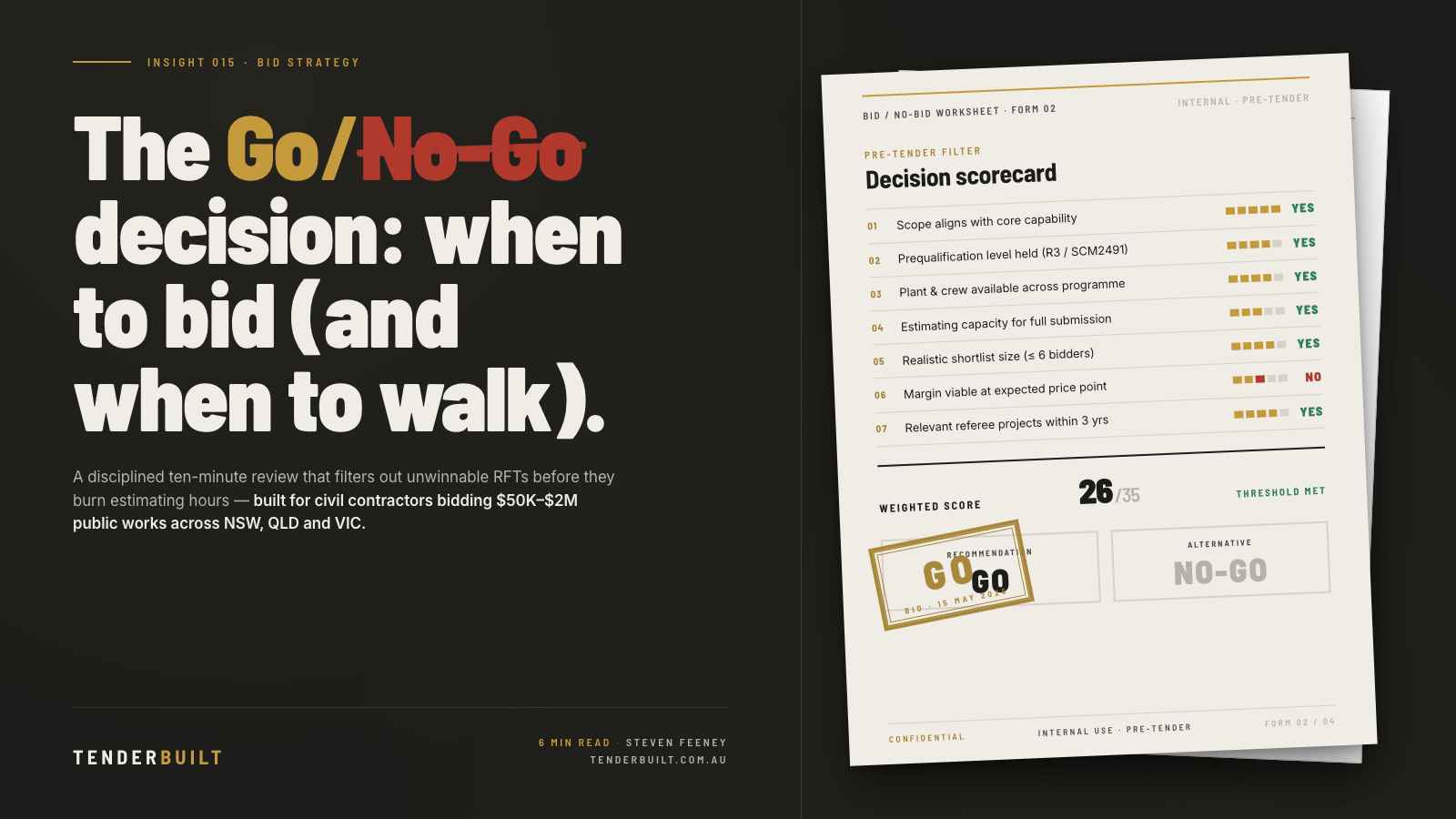
The 12-question go/no-go framework, scoring matrix, and immediate disqualifiers — how Australian civil construction SMEs decide when to big on a civil construction tender, and how disciplined go/no-go calls lift win rates over time.
TenderBuilt — Tender Writing Specialists for Civil Constructiontenderbuilt.com.au
The most important commercial decision in civil construction tendering is not how to write a winning bid — it is whether to bid in the first place. A disciplined go/no-go process is the single most effective tool a civil SME has to lift win rates, reduce wasted bid effort, and free up the time and energy needed to compete properly on the opportunities that matter.
This article sets out the framework. It is written for Australian civil construction SMEs bidding on government and council contracts in the $50K–$2M range, where every tender consumes 40–80 hours of internal preparation time and the wrong “yes” costs as much as the right “yes” in time, money, and morale.[1] It covers the strategic case for saying no, a 12-question evaluation framework, a weighted scoring matrix, the five immediate disqualifiers, and how to build the discipline into a formal process. It complements our pillar guide on writing a winning civil construction tender and our diagnostic on common tender mistakes.
The framework draws on the Australian-specific bid/no-bid research published by Shokri-Ghasabeh and Chileshe (2016), which surveyed 81 Australian construction companies and found that the top-ranked decision factors in Australia are the client’s financial situation, project risk, project value, and number of competitors — a pattern materially different from the US and UK studies it tested against.[2] It also draws on the Shipley and APMP proposal-management literature that informs most Australian bid consultancy practice, and on BidWrite’s published work on go/no-go discipline.
In This Guide
- Why the go/no-go decision matters more than any other tender decision
- The strategic case for saying no
- The 12-question go/no-go framework
- The scoring matrix — weighting the questions
- The five immediate disqualifiers — automatic no-bid signals
- The grey zone — what to do when the decision is borderline
- Making go/no-go a formal process
- When to override the framework
- The compounding effect of disciplined go/no-go
- Writing the no-bid letter
1. Why the go/no-go decision matters more than any other tender decision
A typical civil construction tender in the $50K–$2M range costs the bidding contractor 40–80 hours of internal preparation time, plus $5,000 to $40,000 in external bid writer fees if professional support is engaged.[1] Cross-industry benchmarks place the average bid response cost at around $47,000, against an average win rate of about 20%, implying roughly $188,000 in bid costs per win at average performance.[3] Procore Australia cites a typical construction industry hit ratio of 5:1 — one win per five tenders submitted.[4] Civil SMEs operating without professional bid support frequently sit at the lower end of that range.
The implication is unforgiving. A bid response submitted on a tender you were never going to win is not just unsuccessful — it is the opportunity cost of the time and money that would otherwise have been available for a tender you could win. As Bob Lohfeld of the US-based Lohfeld Consulting Group put it after 30 years in proposal management: “Making better bid decisions brings about an immediate improvement in win rate and, as an added bonus, lowers your annual cost of proposal development. It is far quicker than hiring better people, improving poor proposal processes or investing in capture and proposal technology.”[5]
For Australian civil SMEs, the math is even simpler. If you submit ten tenders a year at a 15% win rate, you win 1.5 contracts. If you submit six tenders a year at a 30% win rate — which is what disciplined go/no-go combined with proper preparation typically delivers — you win 1.8 contracts, with 40% less bid cost. The wins improve in margin too, because bid effort concentrates on contracts where you can compete properly rather than thinly across opportunities you should have passed.
2. The strategic case for saying no
BidWrite, Australia’s largest bid consultancy, frames the strategic case directly: “Companies who take a more strategic approach to tendering make rational, structured and disciplined decisions about which opportunities are worth pursuing. This more considered approach is a sure way to win more often. As well as increasing your win rate, focussing on the right opportunities saves you time, money, and makes the whole tendering process far less stressful.”[6]
BidWrite’s published work goes further. Drawing on their experience supporting more than 3,000 tenders across 15 years, they note that “the reasons for more than 85% of bid proposal losses through competitive procurement processes are known to the bidder beforehand.”[7] In other words, the information needed to make a better go/no-go decision is almost always available before tender submission. The discipline is in using it.
The Shipley framework, the dominant proposal-management methodology used by Australian bid consultancies, treats the bid/no-bid decision as one of the formal capture-management gates that govern resource allocation across an opportunity portfolio. Shipley’s published guidance is unambiguous: teams that skip the bid/no-bid gate “burn resources on unwinnable contracts.”[8]
3. The 12-question go/no-go framework
The framework below is anchored in the four top-ranked Australian decision factors identified by Shokri-Ghasabeh and Chileshe — client financial situation, project risk, project value, and number of competitors[2] — extended to the practical commercial questions a civil SME needs to answer in the first five working days of a tender period.
Question 1 — Capability
Do we have the technical capability and prequalification level required? Red flag: Austroads National Prequalification System (NPS) registration not held for road agency work; NSW SCM scheme registration absent; no relevant ISO certifications.
Question 2 — Capacity
Do we have the resources — people, plant, subcontractors — to deliver if we win? Red flag: already at 80%+ utilisation across the delivery period; key personnel committed elsewhere; no plant available in the construction window.
Question 3 — Experience
Do we have directly relevant project examples within the past five years that we can use? Red flag: the closest example is seven or more years old, or in a different scope category, or at materially different scale.
Question 4 — Geographic
Is the project in our preferred working area? What are the mobilisation costs? Red flag: four or more hours’ drive from the nearest depot, no local subcontractor relationships, no local labour available, or geographic incompatibility with the procuring agency’s local content expectations.
Question 5 — Client relationship
Do we have an existing relationship with this client? Have we delivered for them before? Red flag: cold-bid, no prior contact with the procurement team, no agency briefings or industry days attended.
Question 6 — Competitive position
Who else is likely to bid? Are we plausibly in the top three likely shortlisted? Red flag: a Tier-1 incumbent who has delivered this client multiple times; market full of cheaper, more local competitors; no defensible differentiator to set us apart.
Question 7 — Commercial
Does the price range align with our cost base? Can we win at a price that is profitable? Red flag: indicative budget below our P&G plus risk minimum; principal’s last awarded price for similar work is below our cost-to-deliver.
Question 8 — Risk profile
What are the contract risks — liquidated damages, defects liability, performance security, indemnity carve-outs? Red flag: liquidated damages at 1% of contract value per day uncapped; 20% bank guarantee for performance security; AS 2124 with onerous special conditions; uncapped consequential loss exposure.
Question 9 — Resources to bid
Do we have the time and capability to write a competitive submission? Red flag: fewer than three weeks remaining; key estimator on leave during tender period; no methodology lead identified; existing tender pipeline already at capacity.
Question 10 — Strategic fit
Does this work align with our growth strategy and target portfolio? Red flag: outside our category strategy; one-off opportunity with no pipeline behind it; client we are deliberately scaling away from.
Question 11 — Compliance
Do we meet all mandatory criteria — prequalification, certifications, financial requirements? Red flag: below the financial level required under the NSW Buy NSW Financial Assessment scheme;[9] ISO certifications not in place; mandatory experience requirements not met.
Question 12 — Win themes
Can we articulate two or three concrete reasons we should win this specific contract? Red flag: no clear differentiators; the story is “we’ll do a good job at a fair price”; no customer-specific value proposition.
4. The scoring matrix — weighting the questions
A weighted scoring matrix turns the framework into a decision tool. Score each question 1 (poor fit) to 5 (excellent fit), apply the weights below, and compare to the threshold.
| Question | Weighting | Notes |
|---|---|---|
| 1. Capability | 15% | Pass/fail at base level; weighting applies to depth above the threshold |
| 2. Capacity | 10% | Hard constraint — no point winning what you cannot deliver |
| 3. Experience | 15% | Highest evaluation weighting in most civil tenders |
| 4. Geographic | 5% | Higher weighting for regional or remote work |
| 5. Client relationship | 10% | Strongly correlated with win rate |
| 6. Competitive position | 10% | Apply realistic assessment, not optimistic assessment |
| 7. Commercial | 10% | Margin discipline matters more than top-line revenue |
| 8. Risk profile | 5% | Higher weighting for D&C and complex contracts |
| 9. Resources to bid | 5% | If you cannot prepare a quality submission, the win rate proxy is zero |
| 10. Strategic fit | 5% | Higher weighting in mature businesses with a defined portfolio strategy |
| 11. Compliance | Pass/fail | Any “fail” = no-bid regardless of total score |
| 12. Win themes | 10% | If you cannot articulate why you should win, you probably will not |
Indicative weightings — calibrate to your portfolio strategy and update annually based on debrief findings and won-versus-lost analysis.
Threshold guidance: a weighted score below 3.0 is a no-bid. A score between 3.0 and 3.5 is in the grey zone and requires senior review or restructuring. A score above 3.5 supports a go decision. Compliance is pass/fail — any failure on Question 11 is an automatic no-bid regardless of total score.
5. The five immediate disqualifiers — automatic no-bid signals
Before you score the framework, run the immediate-disqualifier check. Any one of these is an automatic no-bid:
- No prequalification scheme registration where mandatory. Not on Austroads NPS for state road authority work, not on NSW SCM1461 for $1m–$9m work, not on the Victorian Construction Supplier Register for VIC public construction. The tender will be discarded at compliance check regardless of substance.
- Missing ISO certifications where mandatory. ISO 9001, ISO 14001, and ISO 45001 must be issued by a JAS-ANZ accredited certification body. NSW SCM0256 and SCM1461 require ISO 9001 and ISO 45001 as a minimum.[10]
- Mandatory experience requirements not met. Where the brief specifies “must have completed three projects of $X value within five years,” and you have not, the tender is unwinnable.
- Geographic incompatibility. NSW contracts above $3 million carry mandatory SME and local participation weightings.[11] Victoria’s Local Jobs First Policy applies to contracts above $3 million in metropolitan Melbourne and $1 million in regional Victoria. Queensland’s QPP 2026 emphasises Queensland SME participation. A bid from a remote contractor with no local presence will be uncompetitive on the social and local criteria regardless of price.
- Contract risk above tolerance. Uncapped liquidated damages, uncapped consequential loss exposure, unbalanced AS 2124 with onerous special conditions, performance security at 20% of contract value, or financial-level requirements you do not hold. These are dealbreakers — bid only if the special conditions can be negotiated.
6. The grey zone — what to do when the decision is borderline
Not every borderline decision is a no-bid. The grey zone has three legitimate alternatives to walking away:
Conditional bid
Where one or two specific elements of the tender are problematic — a particular special condition, an unrealistic timeframe, an ambiguous scope item — a conditional bid that prices the work assuming clarifications are agreed can be a credible response. Document the conditions explicitly in the Statement of Compliance and Departures.
Partner or joint venture
For tenders that fail the capability or capacity gate but where the strategic opportunity is significant, a JV with a Tier-2 or Tier-1 partner — or a teaming arrangement with a complementary local SME — can convert a no-bid into a viable bid. The JV adds the missing capability or capacity; the SME contributes specific local knowledge or specialist expertise.
Expression of interest as a low-cost test
Where the principal has issued an EOI before the formal tender, the cost of responding is much lower than a full tender. Use EOIs to test market positioning, build relationships with the procurement team, and gather intelligence about the eventual scope and shortlisted competitors before committing to the full bid.
BidWrite’s “Three Cs” framework provides a useful checkpoint for grey-zone calls: Customer (do we know them?), Competition (can we beat them?), Capability (can we deliver?). All three must be “yes” or it is a no-bid by default.[12]
7. Making go/no-go a formal process
The framework is only as good as the discipline that runs it. Three operational rules separate effective go/no-go practice from theoretical practice:
Decision-makers
Three people minimum: the BD or estimating lead (capture intelligence), the operations lead (capacity and risk view), and the General Manager or owner (commercial and strategic call). For larger SMEs, finance signs off on the commercial constraint. The decision is collective; no single person should be able to commit the firm to a tender effort.
Timing
The decision must be made in the first five working days of the tender period. Earlier means more leverage to influence requirements (through clarifications), more time to build a competitive submission, and more cost saved if the decision is no-bid. A go/no-go decision made in the final week of a four-week tender is usually a yes-by-default — the tender effort is already largely sunk.
Documentation
Every go/no-go decision should be documented — wins and losses both. The annual review of decisions versus outcomes is the diagnostic that calibrates the framework. If your “go” decisions are losing more often than expected, the framework or the scoring is mis-weighted; if your “no-go” decisions are turning into competitor wins where you would have been competitive, the scoring is too conservative.
Practical tip. Run a quarterly “go/no-go review” meeting: pull the last three months of decisions, look at outcomes for the “go” decisions, look at competitor outcomes for the “no-go” decisions, and adjust the framework weightings if the patterns suggest mis-calibration. This is the most underused continuous-improvement loop in civil SME bid management.
8. When to override the framework
The framework is a default, not a constraint. There are legitimate reasons to override a no-bid recommendation:
- Market entry bids. Bidding on a new agency or geography to establish presence, accepting a lower expected win rate as the cost of acquisition.
- Relationship bids. Bidding against an incumbent we want to displace, knowing first-time win probability is low but wanting to be a credible challenger next time.
- Capacity-utilisation bids. During slow periods, bidding more aggressively on borderline opportunities to keep crews and plant utilised.
- Strategic capability development. Bidding to develop and demonstrate a new capability — for example, the first Aboriginal Participation Plan, the first Social Procurement Plan — even where the immediate win probability is low.
The discipline for overrides: document the strategic rationale explicitly, pre-agree the expected (lower) win rate and a bid-cost cap, and treat the spend as a marketing or capability-development investment rather than a BD pursuit. The override should not become the default.
9. The compounding effect of disciplined go/no-go
Disciplined go/no-go produces three compounding benefits:
- Fewer bids submitted, higher quality on each. When bid effort concentrates on six tenders rather than spreads across ten, each individual bid receives more methodology development time, more experience tailoring, more review.
- Higher margin on won contracts. Better-prepared tenders allow more time for value proposition development, less reliance on price competitiveness as the primary lever.
- Fewer unsuccessful bid costs. The 40% reduction in bid volume that typical disciplined go/no-go produces is a meaningful cost saving in itself, freeing up cash that can be reinvested in capability building, prequalification renewals, or marketing.
The cumulative effect over 12 to 24 months is the single largest available improvement lever for civil SMEs operating without professional bid support. Cross-industry research from the Association of Proposal Management Professionals suggests companies with structured proposal processes achieve win rates up to 21% higher than those without; companies that conduct formal win-loss analyses achieve about 15% higher win rates.[13] These are cross-industry, directional figures rather than Australian construction-specific data — but the order of magnitude is consistent with what BidWrite, Aurora Marketing, and other Australian consultancies report from their own client work.
10. Writing the no-bid letter
A no-bid does not mean ghosting the buyer. Where you have been formally invited to tender or have engaged with the procurement team during the open period, a brief no-bid letter does three useful things at near-zero cost: it preserves the relationship, it positions you as a credible future supplier, and it occasionally surfaces scope or timing changes that turn the bid back into a “go.”
BidWrite’s published advice on no-bid letters captures the practical case: “Deciding not to tender can help you win” — by preserving relationships and creating opportunities for future invitations.[14] The letter should be brief: a thank-you for the invitation, a high-level reason for declining (timing, capacity, scope mismatch), and a positioning statement about future opportunities you would welcome.
For civil SMEs, this is also AS 4120 Code of Tendering compliance in spirit. The Code requires that “tenderers shall only tender where they intend to carry out the work.”[15] A no-bid letter is the professional way to signal that a particular tender does not meet that test.
Where to go from here
The go/no-go decision is the highest-leverage discipline available to civil SMEs operating in Australian government and council procurement. It costs nothing to implement, requires no new technology, and compounds over time as the framework calibrates to the actual win-loss patterns in your portfolio. Most importantly, it produces an immediate improvement in bid quality on the tenders you do pursue, because the bid effort is no longer thinly distributed across opportunities you should never have chased.
For a deeper view of how the win-rate economics translate into a return-on-investment case for professional bid support, see our companion analysis on the ROI of professional bid management and the diagnostic on when to hire a tender writer versus DIY.
References
- Industry tender preparation cost estimates — GovBid.com.au, “A Guide to Winning a Tender for Construction in Australia” (40–80 hour preparation benchmark) — govbid.com.au; The Tender Team, professional fees schedule (small tenders from $2,200, major project bids $40,000+) — thetenderteam.com.au. ↩
- Shokri-Ghasabeh, M. & Chileshe, N. (2016), “Critical factors influencing the bid/no bid decision in the Australian construction industry,” Construction Innovation, 16(2), 127–157 — DOI 10.1108/CI-04-2015-0021. Survey of 81 Australian construction companies; top-ranked factors: client’s financial situation, project risk, project value, number of competitors. ↩
- Capabilitystatement.com.au, “Tender Advantages and Disadvantages: Complete Guide for Australian Businesses” — capabilitystatement.com.au. Industry estimate; presented as directional cross-industry figure rather than Australian construction-specific data. ↩
- Procore Australia, “The Construction Tendering Process Explained” — procore.com/en-au. ↩
- Bob Lohfeld, Lohfeld Consulting Group, in Washington Technology on bid decisions, widely cited in proposal-management literature. ↩
- BidWrite, “Bidding Go or No Go Decisions — the case for a strategic approach” — bidwrite.com.au. ↩
- BidWrite, ibid; figure drawn from BidWrite’s 15-year Australian and New Zealand bid management practice. ↩
- Shipley Associates, Proposal Guide and Capture Guide; bid/no-bid as a formal capture-management gate. Shipley framework discussed in Australian context at madrigal.com.au. ↩
- NSW Buy NSW Financial Assessment scheme — financial level requirements published in scheme guidance and discussed in our companion guide at tenderbuilt.com.au/buy-nsw-financial-assessment-services-scheme. ↩
- NSW Government prequalification scheme requirements — SCM0256 (≤$1m) and SCM1461 ($1m–$9m); see isosafe.com.au. ↩
- NSW SME and Regional Procurement Policy and NSW Procurement Policy Framework (December 2024) — info.buy.nsw.gov.au. Construction contracts above $3 million carry mandatory minimum 10% SME and local participation weighting plus 10% economic, ethical, environmental, and social weighting. ↩
- BidWrite, “The Three Cs: a look at bidding through our strategic lens” — bidwrite.com.au/three-cs. ↩
- Cross-industry research cited in Association of Proposal Management Professionals (APMP) literature and CSO Insights / Miller Heiman Group studies on win-rate improvement from structured proposal processes and formal win-loss analyses. Presented as directional indicators rather than Australian construction-specific data. ↩
- BidWrite, “No-bid letters: Deciding not to tender can help you win” — bidwrite.com.au/no-bid-letters. ↩
- Standards Australia, AS 4120–1994 Code of Tendering, Clause 4(d): “Tenderers shall only tender where they intend to carry out the work.” ↩
Better bid decisions start before the writing does.
TenderBuilt specialises in tender writing and bid management for civil construction SMEs across NSW, Queensland, and Victoria — including go/no-go strategy, capture planning, and full bid management for contracts in the $50K–$2M range.Get a Free Quote