
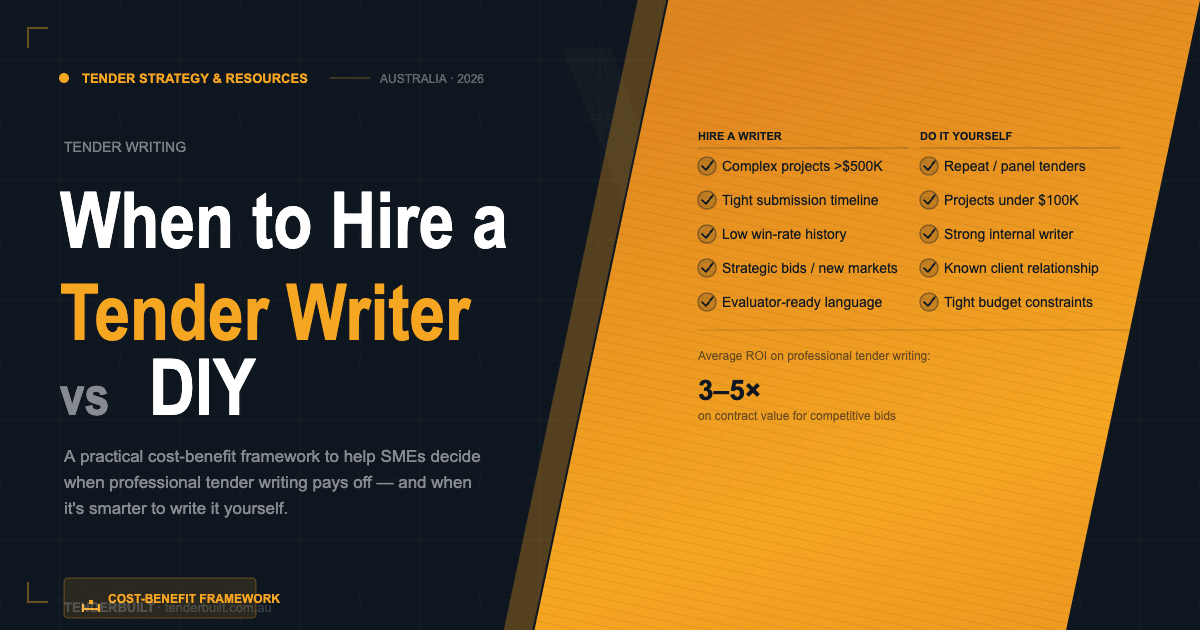
For an Australian civil construction SME, the question of whether to hire a professional tender writer is ultimately a question of opportunity cost, win-rate uplift, and strategic fit — not price alone. A methodology-heavy government Request for Tender typically consumes 40 to 80 hours of senior staff time to prepare.[1] Professional tender writing services in Australia cost between $2,200 and $40,000+ per submission.[2] Australian bid consultancies publish win rates of 70% to 98.5% against an industry-standard average of around 20%.[3]
At the same time, the Australian procurement environment is growing both larger and more complex. The Major Public Infrastructure Pipeline is valued at $242 billion over 2024–25 to 2028–29,[4] and new procurement reforms — Queensland’s QPP 2026, Victoria’s strengthened Local Jobs First Act, NSW’s local-jobs direction, and the revised Commonwealth Procurement Rules that took effect on 17 November 2025 — add social procurement, Indigenous participation, local content weightings, and ethical-conduct criteria to tender evaluation.[5] More criteria means more returnables. More returnables means a higher marginal return on professional help.
This guide synthesises current Australian evidence to give civil construction SME owners a defensible, quantitative framework for the hire-versus-DIY decision. For foundational context, read our pillar guide on how to write a winning civil construction tender.
1. What tender preparation really costs in hours
Every Australian bid specialist and procurement education source that publishes time benchmarks lands in the same range: 40 to 80 hours for a substantive government tender. GovBid, an Australian AI tender platform, notes that a simple Request for Quote might take 10 to 20 hours, while a complex Request for Tender for a major service contract requires 40 to 80 hours of focused work, often spread across multiple people.[6] For civil construction specifically, GovBid observes that pulling together a quality response typically takes 40 to 80 hours — a serious investment for any SME.[7]
Capability Statement’s national procurement guide puts the figure even more bluntly: a standard 10–15 criteria tender requires 40 to 80 hours of work, and most businesses underestimate preparation time by approximately 50%.[8] For methodology-heavy civil RFTs with multiple reviewer gateways, that envelope routinely expands — The Tender Team describes larger infrastructure bids as taking months to prepare across multi-disciplinary teams.[9]
Opportunity cost for an owner-operator
The 40–80 hour figure typically falls on the business’s most senior people — the estimator, the project manager, and most often the owner. Assume a single RFT consumes 60 hours of owner time, and assume a typical civil construction SME pursues six government tenders a year. That is 360 hours annually — approximately nine full working weeks, or 17% of a 2,080-hour working year — diverted from site management, client relationships, cash flow, and business development.
That opportunity cost compounds. Industry analysis co-authored by BidWrite and KordaMentha estimated that in FY2022–23 the Australian Defence industry invested $1.4 billion in bid costs — roughly 1.5% of contract value per bidder, with up to $30 million (30% of bid costs) in real dollars and approximately $970 million in time.[10] While civil construction RFTs at the $50K–$2M level are smaller, the underlying economics scale. Roughly 1–1.5% of contract value is absorbed in bid preparation. For a $500,000 tender, that is $5,000 to $7,500 of absorbed cost per submission — whether or not you win.
2. Win rates — the most-quoted and most-variable statistic
The win-rate question sits at the heart of the hire-versus-DIY decision, because every other variable — fee, time cost, risk — is dwarfed by the expected-value swing between winning and losing. Unfortunately, the Australian data is imperfect. There is no ABS-certified national tender win-rate statistic. What exists is a set of consultancy-published figures, plus a small body of industry-survey data.
The industry-average baseline
The most widely cited figure is that the industry-standard average win rate for Australian tenders is approximately 20%. BidWrite co-founder David Lunn has been quoted directly on this point across multiple industry publications.[11] Capability Statement’s procurement guide suggests Australian SMEs typically win between 12% and 34% of bids, with disciplined feedback review cited as the pathway from the former to the latter.[12] SparrowGenie’s cross-industry data places most contractors winning 20 to 30 percent of the bids they chase, with top performers consistently clearing 60 percent.[13]
Published win rates from professional services
Australian bid consultancies publish strong — if self-reported — win rates:
- BidWrite reports an approximately 70% win rate compared with an industry average of around 20%,[14] and for one construction client (Doval Constructions) reports a win rate of over 90% across more than a dozen prequalification submissions, EOIs, RFPs, and RFTs.[15]
- Aurora Marketing publicly claims a 98.5% win rate and over $170 billion in projects secured.[16]
- Proof Communications reports more than 80% of clients winning their tenders across 1,543+ responses since 2000.[17]
- AI-augmented platforms such as BidWriteGPT and Doreva report a 70% reduction in time spent on tender responses and 30 to 40% higher win rates for users.[18]
How to read these numbers honestly
These figures are marketing statistics from consultancies and should be read critically. They typically reflect three compounding effects that lift the headline number:
- Client-selection bias — consultancies decline to take on weak bids, so the denominator excludes the lowest-probability submissions.
- Bid/no-bid discipline — professionals apply qualification filters that owner-operators rarely do. “Submitting five quality tenders beats submitting fifteen rushed ones.”[19]
- Incumbent and strategic work — several published case studies involve Tier-1 contractors with pre-existing client relationships, which is a very different market from a first-time SME tendering for a council contract.
Even discounting heavily for bias, the realistic gap between a well-prepared professional submission (in the 50–70% range) and a time-constrained DIY submission (in the 12–25% range) is large enough to be the dominant financial lever in the decision. Capability Statement notes that systematic feedback review can improve win rates from 12% to 34% over 18 months — a 2.8× uplift achievable even without a professional writer, purely through disciplined debrief capture.[20]
3. The cost of professional tender writing in Australia
Pricing in the Australian tender writing market is less transparent than in the UK or US, but enough consultancies openly publish rates to establish credible ranges.
Hourly and day rates
| Consultancy / market level | Published rate |
|---|---|
| The Tender Team (Sydney) | $165 + GST per hour (tender writer); tiered rates for bid manager and director levels[21] |
| The Tender Team (alternative listing) | $140 + GST per hour for tender writing; $100 + GST per hour for graphic design[22] |
| Australian market range (general) | $100 + GST to $240 + GST per hour[23] |
Source: published rate cards from Australian tender consultancies, current as of 2025. Rates vary with consultant seniority, engagement type, and urgency.
Full-time tender writer salaries in Australia cluster around $87,500 to $166,660 per year, averaging approximately $112,000 or $57.44 per hour.[24] That baseline establishes why consulting rates sit two-and-a-half to four times higher — they include overheads, on-costs, expertise premium, and profit margin.
Fixed project fees for tenders in the $50K–$2M range
| Source | Published fee range | Context |
|---|---|---|
| The Tender Team | $2,200 to $40,000+ GST per tender (average $4,000–$8,000 + GST) | End-to-end writing and submission management[25] |
| MyConsulting (Melbourne) | $2,750 to $5,500+ | Dependent on tender complexity and supporting policy documentation[26] |
| GovBid (complex-bid rule of thumb) | $5,000 to over $50,000 | Applies to large or complex RFTs, not typical SME civil work[27] |
| Tender Writers (Proof Communications) | $1,000 to tens of thousands | Broad guidance across tender complexity levels[28] |
Fee bands drawn from publicly listed pricing on Australian tender consultancy websites.
Synthesising the data: for a typical $50K–$2M civil RFT involving methodology, WHS, environmental, safety, quality, and local-content returnables, the realistic professional-fee range is $4,000 to $15,000 + GST for a standard submission. Complex infrastructure tenders with multiple evaluation criteria and reviewer gateways can push fees to $20,000 to $40,000.
Retainer and subscription models
BidWrite operates “Secure” and “Transform” subscription packages that embed a bid team into a client organisation and provide first right of refusal on competing opportunities.[29] Most Australian consultancies offer monthly retainers priced on a discounted per-bid basis. For SMEs submitting four or more bids annually, a retainer typically reduces unit cost by 15–25% against ad-hoc project engagement.
4. The true cost of DIY tender writing
The obvious cost of DIY is the owner’s time. The less-obvious costs — non-compliance, missed deadlines, reputational damage, and burnout — are substantial, and regularly under-counted.
Owner-operator opportunity cost
Construction and trades businesses run on structurally thin margins. A $5M builder typically supports only $150,000 to $200,000 in owner drawings despite the high revenue, reflecting net margins of 5–12%.[30] ABS data places the average full-time salary in Construction at $96,000 per year in 2025–26,[31] while heavy and civil engineering construction pays the highest in the sector at $132,900 per employee in wages and salaries.[32]
Using a conservative $100-per-hour blended opportunity cost for a civil SME owner — reflecting salary, on-costs, and the margin they could be generating on the tools or winning work — a 60-hour DIY RFT costs $6,000 in owner time alone. That is already at parity with a mid-range professional fee, before counting the risk of losing.
Non-compliance — the silent killer
Non-compliance is the single largest unforced error in Australian tender submissions. Industry estimates suggest around 60% of tender failures occur at the compliance stage, before any evaluator reads the technical response.[33] Under NSW procurement rules, non-compliant tenders are excluded automatically, regardless of how strong the technical response may be.[34] Under Commonwealth Procurement Rules, tenders received after the specified closing date cannot be accepted — full stop, no exceptions.[35]
A cautionary anonymised example cited by Capability Statement: a Brisbane construction firm lost a $2.4M contract because the insurance certificate they uploaded had expired three days earlier — even though the policy had already been renewed. A simple compliance check would have prevented it.[36]
Hidden costs beyond compliance
- Margin erosion from non-strategic bidding. Submitting five quality tenders beats submitting fifteen rushed ones.[19]
- Reputation damage. Poor-quality submissions create evaluator-panel memory effects, lowering future win rates at the same agency.
- Burnout and attrition. BidWrite describes the culture of “late-night pizza runs” that DIY tender writing often creates — with real costs in staff retention.[29]
- Cash-flow drag. Time spent on losing bids is time not spent invoicing, chasing debtors, or closing private-sector work that typically pays faster than government contracts.
5. A break-even analysis you can apply to your next tender
The cleanest way to resolve the hire-versus-DIY question is to put numbers on both sides. Using the industry-standard 20% average win rate as baseline, and assuming a professional engagement lifts win rate to a conservative 40% (half the 70–80% that leading consultancies claim), the expected-value maths is as follows:
| Contract value | DIY expected value (20% × value) | Professional expected value (40% × value) | Maximum fee that breaks even |
|---|---|---|---|
| $100,000 | $20,000 | $40,000 | $20,000 |
| $250,000 | $50,000 | $100,000 | $50,000 |
| $500,000 | $100,000 | $200,000 | $100,000 |
| $1,000,000 | $200,000 | $400,000 | $200,000 |
| $2,000,000 | $400,000 | $800,000 | $400,000 |
Break-even fee is the maximum professional fee at which DIY and professional engagement deliver equivalent expected value. Assumes a 20-percentage-point win-rate uplift from professional help. Contract margins not yet deducted.
Against typical professional fees of $4,000 to $15,000 for $50K–$2M civil RFTs, the expected-value uplift from even a modest win-rate improvement vastly exceeds the fee at the upper end of the contract-value range. BidWrite frames the same calculation differently: the average tendered contract in Australia is worth $923,224, which is why the consultancy can quote a 36,903% ROI for its $2,495 training course when it leads to a single additional win.[37]
Worked example. A civil SME bids on a $700,000 earthworks contract. DIY expected value at 20% is $140,000. Engaging a professional at a $10,000 fee, and assuming a 40% win rate, delivers an expected value of $280,000 less the $10,000 fee — a net expected value of $270,000, or $130,000 more than the DIY path. Even halving the assumed uplift (to a 30% win rate), the professional engagement still delivers $200,000 in net expected value — $60,000 better than DIY.
6. Why 2024–2026 policy reforms raise the case for professional help
This is the single most underappreciated dynamic in the Australian civil tender market. Governments across all jurisdictions are using procurement as a social and economic-policy lever, which simultaneously increases SME opportunity and raises the complexity bar for tender responses.
Commonwealth Procurement Rules — 17 November 2025
The most extensive overhaul in nearly a decade took effect on 17 November 2025.[38] Key changes include:
- Non-construction procurement threshold raised from $80,000 to $125,000 (first increase in 20 years).
- Construction threshold unchanged at $7.5 million.
- Non-corporate Commonwealth entities must only invite Australian businesses to tender for non-panel procurement below the procurement threshold.
- Ethical conduct is now an explicit factor in value-for-money assessment.[39]
- From 1 July 2024, the SME sourcing target rose to 25% of procurements below $1 billion and 40% of procurements below $20 million.[40]
- The Indigenous Procurement Policy target rose to 3% from 1 July 2025, rising 0.25% annually to 4% by 2029–30.[41]
Queensland — QPP 2026
Effective 1 January 2026, the Queensland Procurement Policy 2026 slashed the policy document from 700 pages to 50 pages and locks in a 30% SME participation target, effectively earmarking $10.5 billion of annual government spend for SMEs.[42] A new Queensland Supplier Code of Conduct, tiered Procurement Assurance Model, and 10–30% local-benefits evaluation weighting on significant tenders all add new returnables.[43] See our detailed analysis in Queensland’s $35 billion procurement shake-up: QPP 2026.
NSW procurement reforms
From 31 December 2024, all procurements exceeding $150,000 (including GST) must be published on buy.nsw under PBD 2024-01.[44] PBD 2024-02 “Increasing opportunities for local suppliers” (effective 1 January 2025) applies to all goods, services, and construction procurement valued over $7.5 million, requiring agencies to check NSW-based supplier capability and report quarterly.[45] For contracts exceeding $7.5 million, Aboriginal Participation Plans with targets typically set at 1.5% of project value are required.[46]
Victorian Local Jobs First — strengthened 20 August 2025
The Local Jobs First Amendment Bill 2025 passed both houses of Victorian Parliament and received Royal Assent on 19 August 2025.[47] Amendments to the Local Jobs First Act 2003 focus on compliance and enforcement of Local Industry Development Plans and strengthen the powers of the Local Jobs First Commissioner. Victoria’s Social Procurement Framework embeds seven social and three sustainable procurement objectives into all goods, services, and construction procurement, with scalable requirements triggered at $1M, $3M, $20M, and $50M thresholds.[48]
What this means for your tender-writer decision
Every one of these reforms adds evaluation criteria — social procurement, Indigenous participation, local content, apprentice hours, Fair Jobs Code, Supplier Codes of Conduct, ethical conduct. Each criterion is a returnable that requires evidence. The pre-2022 world where a civil SME could win on price, track record, and a three-page methodology statement is over. See our detailed guidance on social and Indigenous procurement in NSW, VIC, and QLD for the full criteria map.
The logical consequence: as criteria proliferate, the marginal return on professional tender writing rises, because professionals specialise in mapping response content to evaluation criteria, assembling evidence, and ensuring compliance across returnables an owner-operator has never seen before.
7. Common objections — and why they rarely hold up to maths
Industry commentary consistently identifies a common set of owner-operator objections. These are genuine concerns but map poorly to the actual economics.
“It’s too expensive”
The objection usually compares the professional fee to cash outlay rather than to expected value. As the break-even analysis above shows, for any contract above roughly $100,000 in value, even a conservative win-rate uplift from professional help more than covers a typical fee. The underlying driver of this objection is often lack of understanding and fear of failure rather than pure cost aversion.[49]
“No one can write about our business like we can”
This is partially true — and entirely beside the point. A professional tender writer’s value lies in combining your subject-matter expertise with their persuasion, structure, and compliance craft. Your team provides the core knowledge and strategic thinking; the writer handles mapping that content to evaluation criteria, compliance matrices, and document design.[50]
“I’m worried about quality and trust”
Quality varies, and this is a legitimate concern. The risk is managed through due diligence: APMP certification, Shipley methodology training, professional indemnity insurance, and published civil construction case studies. BidWrite, for instance, holds the only APMP Accredited Training Organisation status in Australasia, and describes itself as having proportionately more APMP-accredited people than any other Australian organisation.[51]
“What about confidentiality and conflict of interest?”
Reputable consultancies offer exclusivity guarantees. BidWrite’s long-held position is that it will never support multiple organisations competing for the same opportunity.[52] This should be written into the engagement terms before any work starts.
“I should be able to do this myself”
A common construction-industry mindset. The Thornton & Lowe analysis frames it as a category error: if you’re bidding only a small number of times per year, you’re either under-utilising expensive resource or compromising quality by spreading people too thin.[53] Bidsmith puts it plainly: bringing in a specialist team when you need it is almost always better value than asking staff with no tendering experience to attempt it — it also keeps your revenue-producing staff focused on generating income, not writing tenders on weekends.[54]
8. The hybrid engagement model most SMEs should consider
For many civil construction SMEs, neither full DIY nor full outsourcing is optimal. The dominant pattern in 2024–2026 is a hybrid engagement model:
- Internal ownership of project methodology, programme, pricing, and technical sections — where the SME’s competitive edge genuinely lives.
- External professional support for strategy development, compliance matrix construction, writing to evaluation criteria, social procurement and local content plans, executive summaries, and document design.
- Review-only engagements for SMEs with some tendering capability. At $165 + GST per hour, a professional review of a typical $500K–$2M civil RFT runs 5 to 12 hours — $825 to $1,980 + GST — and typically lifts submission quality materially.[55]
AI-augmented workflows are reshaping this middle ground. Platforms like BidWriteGPT, Doreva, and GovBid report 70% reductions in time spent on tender responses and 30 to 40% higher win rates.[56] Critically, the vendors themselves stress that AI does not replace team expertise — it amplifies it. Your team provides the core knowledge and strategic thinking; the AI handles structure and initial writing.[57]
9. A practical decision framework
Applying the evidence, an Australian civil construction SME owner should strongly consider hiring a professional tender writer when three or more of the following apply to a specific RFT:
- Contract value ≥ $300,000. The expected-value uplift from professional help exceeds $30,000 at a 15-percentage-point win-rate improvement.
- Evaluation complexity. The RFT contains 8+ weighted criteria, or carries Social Procurement Framework, Local Jobs First, Indigenous Participation, or Supplier Code of Conduct returnables.
- Internal capacity gap. The owner, estimator, or PM cannot dedicate 40+ uninterrupted hours within the submission window.
- Strategic contract. Winning unlocks a prequalification scheme, panel seat, or recurring client relationship — Transport for NSW, Major Road Projects Victoria, TMR Queensland, or similar.
- Loss history at the same agency. Two or more prior unsuccessful submissions signal a capability gap that a professional can diagnose through debrief analysis.
- Short deadline (under three weeks) combined with live project delivery already absorbing senior staff.
- New tender category. The business is bidding into a jurisdiction, evaluation framework, or specialisation for the first time.
Conversely, DIY remains the rational choice when:
- Contract value is under $100,000–$150,000 and the RFQ is straightforward.
- The SME has recent wins at the same agency that provide a strong content library.
- An internal estimator or BDM holds APMP Foundation or higher certification.
- The tender is an incumbent renewal with largely refreshed content.
- The opportunity is marginal on strategic fit — in which case a no-bid is the better answer regardless.
The bid/no-bid question comes first. Research consensus is clear: teams winning 60%+ of bids are not submitting more proposals. They are submitting fewer, better-qualified responses.[58] Before deciding how to resource a tender, decide whether to bid at all. A disciplined bid/no-bid scoring matrix — rating strategic fit, probability of winning, profitability, evaluator relationship, existing content, available capacity, and deadline feasibility — is the single highest-leverage discipline in tender strategy.
10. How to evaluate a tender writer before you engage them
Quality varies substantially across the Australian market. Ask for documented evidence of the following before signing any engagement:
- APMP certification level(s) of the lead consultant. The Association of Proposal Management Professionals (APMP) is the global industry body for proposal and bid professionals.[59] Three Signature Certification levels exist: Foundation (minimum 1 year of experience), Practitioner (3–7 years, with practitioner-accredited members reportedly earning an average of 35% more than peers),[60] and Professional (7+ years, top-level certification).
- Shipley methodology or equivalent training. Shipley Associates has developed and codified proposal methodology since 1972 and is a globally Approved Training Organisation with APMP.[61]
- Civil construction sector experience. Published case studies with SMEs of comparable size, contract value, and jurisdiction.
- Exclusivity guarantee on competing bids, written into the engagement terms.
- Professional indemnity insurance and written engagement terms. Some Australian tender writers operate ISO-certified quality management systems — Proof Communications, for example, is ISO 9001 certified.[62]
- Transparent fee structure — hourly, fixed, or retainer — aligned to the scope, with a clear definition of what is in and out.
- Content hand-over of reusable material, so your internal library grows with each engagement.[63]
- Win-rate transparency. Ask whether published win rates include sole-source, incumbent, or pre-positioned submissions, and what the denominator actually is.
For detailed guidance on what evaluators look for once your submission reaches the panel, see how government tenders are scored.
11. Practical next steps
The hire-versus-DIY decision is rarely a one-time call. It is a standing decision you should revisit for every opportunity. To build a durable process:
First, build a bid/no-bid scoring matrix and apply it to every opportunity before deciding how to resource it. The discipline of qualifying out the bottom third of opportunities frees capacity for the top third — where hiring a professional, engaging hybrid support, or investing in a polished DIY submission becomes economically obvious.
Second, calculate your own break-even. Use a conservative 15-percentage-point win-rate uplift assumption and plot your break-even fee across the contract-value range you typically bid. Revisit the assumption each time you complete a win/loss debrief.
Third, interview two or three professional tender writers before you need one. The worst time to select a consultant is in the final week of a submission deadline. Ask for a fixed-fee quote on a sample RFT you’ve recently lost, and compare both the price and the strategic diagnosis they provide.
Fourth, build your internal content library. The single largest lever in reducing future tender preparation time — whether DIY, hybrid, or fully outsourced — is a well-maintained library of company overviews, methodology statements, WHS and environmental content, case studies, and resumes. Make content capture a default output of every tender, not an afterthought.
Fifth, run systematic debriefs. Capability Statement’s benchmark — lifting win rates from 12% to 34% over 18 months through disciplined feedback review — is achievable without spending a single dollar on consultants. The gap between high-performing and low-performing tender teams is often not talent, but process discipline.
The question is rarely “can I afford a tender writer?” It is “can I afford to keep losing tenders I could have won?” For SMEs bidding on the $242 billion infrastructure pipeline, the answer — on the evidence — is almost always no. For practical guidance on the other side of this decision, read our guide to civil contractor prequalification in Australia, which sets out the structural requirements that sit behind every competitive tender.
References
- GovBid, Define Tender in Business: A Guide for Australian SMEs — govbid.com.au/define-tender-in-business. 40–80 hour preparation benchmark for standard RFTs. ↩
- The Tender Team, Tender Writing Fees and Rates — thetenderteam.com.au/fees-tender-writing-rates. Fee range $2,200 to $40,000+ GST per tender. ↩
- BidWrite / GPTStrategic — AI Revolutionises Tender Writing, reported by Mi3 — mi-3.com.au. BidWrite co-founder David Lunn: approximately 70% win rate vs industry average of around 20%. ↩
- Infrastructure Australia, 2025 Infrastructure Market Capacity Report — infrastructureaustralia.gov.au/2025-market-capacity. Major Public Infrastructure Pipeline valued at $242 billion over 2024-25 to 2028-29. ↩
- Department of Finance, Commonwealth Procurement Rules are changing — finance.gov.au. Revised CPRs effective 17 November 2025. ↩
- GovBid, Winning Australian Government Tenders — govbid.com.au/australian-government-tender. Simple RFQ 10–20 hours; complex RFT 40–80 hours. ↩
- GovBid, A Guide to Winning Building Construction Tenders in Australia — govbid.com.au/building-construction-tenders. Construction tender preparation benchmark. ↩
- Capability Statement, Government Tenders Australia: Find, Write & Win — capabilitystatement.com.au/tender/government. 40–80 hour benchmark; 50% time underestimation by most SMEs. ↩
- The Tender Team, op. cit. — large infrastructure tenders described as taking months to prepare. ↩
- BidWrite and KordaMentha, Reducing the $1B+ Cost of Defence Tendering — bidwrite.com.au/reducing-1b-cost-of-defence-tendering. FY22-23 Defence industry bid cost analysis: $1.4 billion; ~1.5% of contract value. ↩
- StartUp ScaleUp, AI Transforms the Business of Tender Writing in Australia — startupscaleup.com.au. 20% industry-average win rate cited by BidWrite. ↩
- Capability Statement, op. cit. — 12–34% SME win rate range. ↩
- SparrowGenie, Tender Bidding: Key Steps, Process & Best Practices (2026) — sparrowgenie.com/tender-bidding. 20–30% typical contractor win rate; 60%+ among top performers. ↩
- BidWrite / Mi3, op. cit. 70% BidWrite win rate vs ~20% industry average. ↩
- BidWrite, Case Studies — Doval Constructions — bidwrite.com.au/case-studies. Over 90% win rate across a dozen-plus prequalification, EOI, RFP, and RFT engagements. ↩
- Aurora Marketing, Bid and Tender Support — auroramarketing.com.au/bidsupport. 98.5% win rate and over $170 billion in projects secured. ↩
- Proof Communications, Professional Business Writing Services — proofcommunications.com.au. More than 80% of clients winning their tenders; 1,543+ responses since 2000. ↩
- Australian Tenders, Best AI Tender Writing and Market Intelligence Tools in Australia and New Zealand — australiantenders.com.au/ai-tender-tools. BidWriteGPT / Doreva vendor statistics. ↩
- Capability Statement, op. cit. — “Submitting five quality tenders beats submitting fifteen rushed ones.” ↩ ↩
- Capability Statement, op. cit. — systematic feedback review lifts win rates from 12% to 34% over 18 months. ↩
- The Tender Team, Fees page, op. cit. $165 + GST per hour tender writer rate. ↩
- The Tender Team, FAQs — thetenderteam.com.au/writing-services/faqs. $140 + GST/hr writing; $100 + GST/hr graphic design. ↩
- The Tender Team FAQs, op. cit. Australian market range: $100–$240 + GST per hour. ↩
- Talent.com, Tender Writer Salary in Australia — au.talent.com/salary. Average $112,000 per year; $57.44 per hour. ↩
- The Tender Team Fees, op. cit. Fixed fee range per tender: $2,200 to $40,000+ GST. ↩
- MyConsulting, Tender Writer Australia — myconsulting.com.au. $2,750 to $5,500+ per tender. ↩
- GovBid, Define Tender in Business, op. cit. Complex-bid rule of thumb: $5,000 to over $50,000. ↩
- Tender Writers (Proof Communications), How much does it cost to write a tender? — tenderwriters.com.au/cost-to-write-tender. ↩
- BidWrite, FAQs — bidwrite.com.au/faqs. Subscription packages and culture commentary. ↩ ↩
- Scale Suite, What Australian Business Owners Pay Themselves by Revenue 2026 — scalesuite.com.au/owner-salaries. Construction SME margins and owner drawings. ↩
- FairWork Mate, citing ABS data — Average Salary Australia 2026 by Industry — fairworkmate.com.au/salary-2026. Construction average full-time salary $96,000. ↩
- Australian Bureau of Statistics, The nuts and bolts of the Australian Construction industry — abs.gov.au/construction-industry. Heavy and civil engineering construction wages: $132,900 per employee, 2023-24. ↩
- Capability Statement, NSW Government Tenders — capabilitystatement.com.au/tender/government/nsw. ~60% of tender failures occur at the compliance stage. ↩
- Capability Statement NSW, op. cit. Non-compliant tenders automatically excluded under NSW procurement rules. ↩
- Australian Taxation Office, The tendering process — ato.gov.au/tendering-process. Tenders received after closing cannot be accepted under CPRs. ↩
- Capability Statement, op. cit. Brisbane construction firm $2.4M loss due to expired insurance certificate upload. ↩
- BidWrite, The ROI of a Tender Training Course — bidwrite.com.au/roi-tender-training. Average Australian tendered contract value: $923,224. ↩
- Clayton Utz, Changes to the Commonwealth Procurement Rules — claytonutz.com/cpr-changes-november-2025. ↩
- MinterEllison, New Commonwealth Procurement Rules commence 17 November 2025 — minterellison.com/cpr-analysis. Ethical conduct now explicit in value-for-money assessment. ↩
- Treasury Ministers, New procurement rules deliver more small business — ministers.treasury.gov.au. 25% SME target below $1B; 40% below $20M. ↩
- National Indigenous Australians Agency, Increased Indigenous Procurement Targets — niaa.gov.au/increased-ipp-targets. Target 3% from 1 July 2025, rising to 4% by 2029-30. ↩
- Queensland Government Ministerial Statement, QPP 2026 announcement — statements.qld.gov.au/103905. 30% SME target; $10.5 billion in annual SME-directed spend. ↩
- GovBid, Queensland Procurement Policy 2026 Guide — govbid.com.au/queensland-procurement-policy. Local benefits test 10–30% of total evaluation score. ↩
- buy.nsw Procurement Policy Framework, PBD 2024-01 — info.buy.nsw.gov.au/policy-framework. Publication of procurements >$150,000 from 31 December 2024. ↩
- Sparke Helmore, NSW Government Procurement Reform Part 5 — Local Jobs First — sparke.com.au/nsw-local-jobs-first. PBD 2024-02 requirements. ↩
- Capability Statement, Tender Thresholds — capabilitystatement.com.au/tender/thresholds. NSW 1.5% Aboriginal participation on contracts over $7.5M. ↩
- Local Jobs First Victoria, Policy updates and transitional arrangements — localjobsfirst.vic.gov.au/updates. Royal Assent 19 August 2025. ↩
- Buying for Victoria, Social Procurement Framework — Requirements and Expectations — buyingfor.vic.gov.au/spf-requirements. $1M, $3M, $20M, $50M thresholds. ↩
- eXceeding, 5 Reasons Why You Should Hire a Professional Bid Writer — exceeding.co.uk/hire-bid-writer. Cost and fear of failure as primary objection drivers. ↩
- BidWrite positioning on human + AI + expertise combination — bidwrite.com.au. ↩
- BidWrite, About BidWrite — bidwrite.com.au/about. Australasia’s only APMP Accredited Training Organisation. ↩
- BidWrite FAQs, op. cit. Exclusivity commitment on competing bids. ↩
- Thornton & Lowe, In-house vs Outsourced Bid Writing — thorntonandlowe.com/in-house-vs-outsourced. Resource utilisation framing. ↩
- Bidsmith, The Case for Outsourcing Your Bid Team — bidsmith.com.au/outsourcing-bid-team. Specialist team vs inexperienced staff. ↩
- The Tender Team Fees, op. cit. Review-only engagement scope and pricing. ↩
- Tech Business News, New AI Platform BidWriteGPT Transforms Tender Writing for Australian Businesses — techbusinessnews.com.au/bidwritegpt. Vendor-reported time reduction and win-rate uplift. ↩
- GovBid, Winning Australian Government Tenders, op. cit. AI amplifies rather than replaces expertise. ↩
- SparrowGenie, op. cit. Top performers submit fewer, better-qualified responses. ↩
- APMP, Major Certifications — apmp.org/certification. Global industry body. ↩
- Sixfold International, APMP Practitioner Accreditation — sixfold.biz/apmp-practitioner. Practitioner-level premium over peers. ↩
- Shipley Asia Pacific — shipleywins.com.au. POWeR methodology and colour-team review gates. ↩
- Proof Communications, Government Tenders — proofcommunications.com.au/government-tenders. ISO 9001 Quality Management Systems certified. ↩
- The Tender Team, How much does it cost for a professional tender writer — thetenderteam.com.au/cost-guidance. Content hand-over as engagement outcome. ↩