
In short
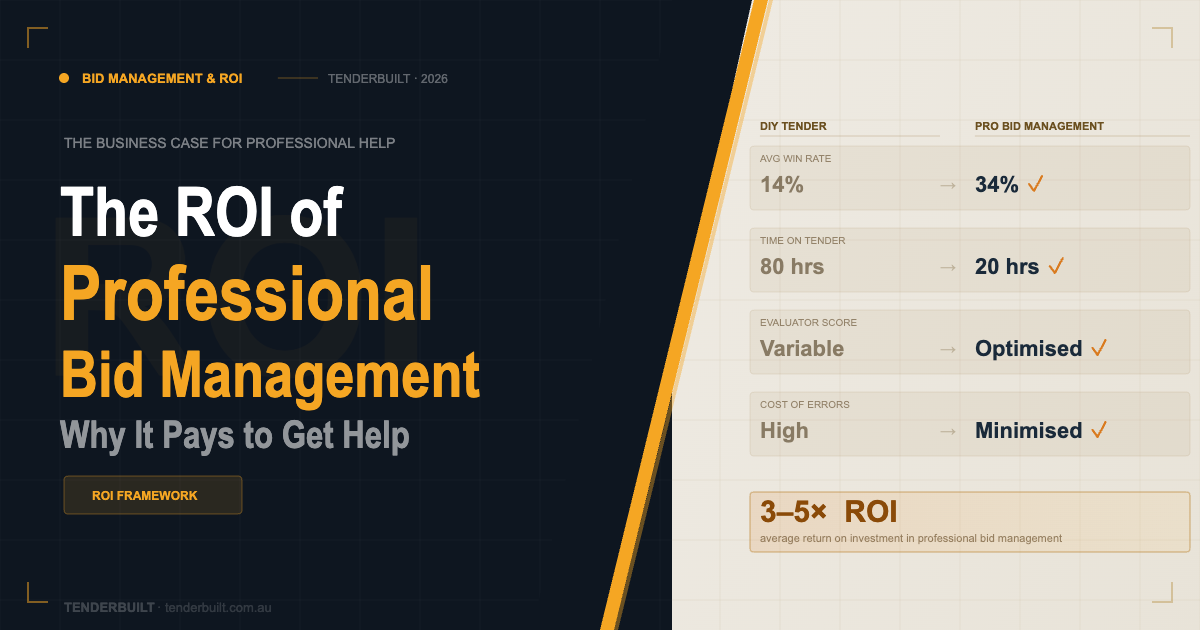
Professional bid management pays back when a single win covers the fee many times over: a $5,000–$15,000 engagement that converts a $500K–$2M contract at an 8–15% margin returns 300–6,000% on fees, and the content library, debrief discipline and compliance protection it installs compound across every later bid, including the ones you write yourself.
For Australian civil construction SMEs, the case for professional bid management is no longer an abstraction. It is mathematics. Across the consultancies that publish performance data, professionally-managed bids consistently win at 75–98.5% — multiples of the 30–45% benchmark for unsupported submissions.[1] The average tendered contract in Australia is worth $923,224,[2] and the typical professional engagement ranges from $2,200 for small bids to $40,000+ for major projects.[3] A single win therefore delivers double or triple-digit return multiples on fees — and subsequent wins compound that return as content libraries, capability uplift and panel positions accrue.
Three structural shifts in 2025–2026 — Queensland Procurement Policy 2026, Victoria’s strengthened Local Jobs First Act, and the revised Commonwealth Procurement Rules — have simultaneously raised the SME share of available work and raised the technical bar for compliant, persuasive bids. In a $242 billion Major Public Infrastructure Pipeline,[4] professional bid management has moved from optional cost to strategic capability investment.
1. Quantified ROI from Australian bid consultancies
BidWrite — Doval Constructions
After an initial engagement to support Doval Constructions’ prequalification submission to Queensland’s Department of Transport and Main Roads, the company continued to engage BidWrite for more than a dozen prequalification submissions, EOIs, RFPs and RFTs, achieving a win rate of over 90%.[5] The relationship evolved into mentorship, with Doval building “a number of skilled in-house tendering staff, an expanding bid library of quality tendering collateral, and a better understanding of how to produce persuasive tenders that win.”[6]
Aurora Marketing and Proof Communications
Aurora Marketing reports a 98.5% success rate and has delivered more than $135 billion in winning tenders for clients since 2001.[7] Proof Communications reports more than 1,568 tender and proposal responses since 2000, with over 80% of clients winning their tenders, helping clients win “hundreds of millions of dollars in new business.”[8]
The Tender Team and The Bid Coordinator
The Tender Team publishes a 90% win rate across 2025 and a $4 million Defence contract for a Federal Government client.[9] The Bid Coordinator — construction-specific — reports a 75% government tender win rate, with clients achieving 50% higher success rate than the industry standard.[10]
The ROI calculation
A civil contractor paying $15,000 for professional support on a $1M road maintenance package who wins achieves an ROI of approximately 6,567% on fees. Even at conservative civil margins of 8–15%, the margin-to-fee return is 533–1,000%.[11] This is why bid consulting fees are correctly classified as growth investment, not overhead.
2. Bid management as an investment category, not an expense
APMP and the professionalisation of bid management
Bid management is a recognised global profession governed by the Association of Proposal Management Professionals (APMP), which has more than 12,900 members across 29 chapters and 16,900+ certified professionals globally.[12] APMP research finds that companies with structured proposal processes and metrics achieve win rates up to 21% higher than those without.[13]
Industry research finds that organisations with structured capture management routinely achieve win rates of 40–60% versus an industry average around 21%.[14] Structured capture management improves win rates by up to 50%.[15]
The compounding value: content, capability, debrief
Content reuse of 60–80% is achieved across mature bid teams, and teams with active libraries reuse 66% of content versus 40% more time spent writing from scratch.[16] Each bid materially reduces the marginal cost of the next. This compounds through capability transfer and win-rate trajectory improvements — the subject of later sections.
Retainer vs project vs in-house
Project-based engagement ranges from $2,200 to $40,000+ per bid across the Australian market — TenderBuilt publishes its own fixed fees per tender, benchmarked in our guide to what a tender writer costs.[17] Retainer engagement suits businesses with consistent bid pipelines. In-house bid managers cost $118,000–$240,000 annually fully loaded — justified only at scale. The hybrid model — a small internal owner plus scalable external partner — is now the recommended approach for SMEs; our guide to when to hire a tender writer versus DIY sets out the break-even.[18]
3. The cost of poor submissions — quantified
The direct cost of a losing bid
Australian benchmark: a tender response takes 40–80 hours of internal effort.[19] For larger civil packages with methodology, programme, WHS, environmental and social-procurement components, responses easily exceed 200 hours. Construction contractors typically spend $2,000–$5,000 preparing each bid.[20] A losing bid is therefore a direct cost of $2,000–$5,000 plus 40–80 hours of opportunity cost, multiplied across every loss.
The Defence tendering analysis
The joint BidWrite and KordaMentha analysis is the most rigorous Australian quantification: bidders invest up to 1.5% of contract value to bid for Defence projects. In FY22-23, Australian industry invested $1.4 billion bidding for Defence work that didn’t deliver. Approximately 27% of issued RFTs fail to result in any contract, meaning “the return on investment for all bidders is 0%” on cancelled tenders.[21]
Compliance failure — the hidden killer
A non-compliant bid is automatically disqualified before any evaluator reads the technical response.[22] Common causes: missing mandatory attachments, unsigned forms, expired insurance certificates, incomplete safety plans, late lodgement. For a civil SME bidding on a $1M road maintenance package, a single non-compliance failure costs approximately $90,000–$160,000 in direct cost, forgone margin, and reputational decay with the buyer.[23]
The rejection cycle
Tender evaluators remember repeated weak submitters. Once a contractor is “a known weak bidder” within a state agency’s evaluation team, the practical effect is a downward spiral: they receive less informal market-shaping engagement, their prequalification is less likely to be upgraded, and panel selection committees default to higher-confidence competitors.[24]
4. Capability transfer and business development benefits
The Doval Constructions case is the canonical example: BidWrite’s role evolved from “writing the bid” to “mentorship,” with Doval developing skilled in-house staff, expanding bid libraries, and “a better understanding of how to produce persuasive tenders that win.”[25] Doval’s internal team now handles smaller tenders independently, calling on BidWrite only for “strategically important, ‘must win’ tenders.” This is the textbook ROI pattern: reducing dependency over time while simultaneously raising the ceiling of the company’s deal-pursuit capability.
APMP’s certification framework (Foundation, Practitioner, Professional, Fellow) provides structured uplift pathways that SMEs can use to internalise know-how.[26] Working with a consultancy on live, must-win bids is the most efficient delivery of the 70% learning that comes from on-the-job experience.[27]
5. Pipeline value and strategic growth — panels and prequalification
The size of the prize
Australia’s Major Public Infrastructure Pipeline stands at $242 billion across 2024-25 to 2028-29 — up 14% in a year and the highest level since Infrastructure Australia began tracking.[28] Queensland’s 2026 procurement spend is approximately $35 billion annually.[29] NSW’s infrastructure commitment is $111.5 billion over four years.[30]
Panels are the highest-leverage entry point
For a civil SME, a single successful panel admission converts to multiple call-off contracts over years without further open competition. Transport for NSW Prequalification classifies contractors by category and financial level; the NSW Government’s $250,000 SME direct-procurement threshold generated more than 1,500 contracts to SMEs in the $150K–$250K band in 2024 alone — 51% of all contracts in that band.[31]
Market consolidation favouring larger contracts
GovBid’s analysis notes that between 2021 and 2025, the total volume of published tenders fell by over 23%. Governments are moving towards fewer, but much larger and more strategic, contracts. For civil SMEs, panel and prequalification position is now more strategically valuable than ever.[32]
6. The Australian bid management industry — sizing and growth
Industry structure and scale
The Australian bid management consultancy market is fragmented but maturing. APMP’s ANZ Chapter membership and the proliferation of named consultancies (BidWrite, Aurora Marketing, Proof Communications, ProposalPro, The Tender Team, Bidsmith, Tender Relief, The Bid Coordinator) reflect a profession in expansion. Aurora Marketing reports approximately A$7m annual revenue and 26 employees.[33]
Bid manager remuneration in Australia
| Source | Base salary / range |
|---|---|
| PayScale (national) | A$118,271 base |
| SalaryExpert (national) | A$147,084 + bonus |
| Glassdoor (Australia) | A$137,000 average; A$79k–A$165k range |
| Glassdoor (Sydney) | A$142,000 average; top quartile A$182k–A$240k |
| SEEK | A$140,000–A$160,000 |
Australian Bid Manager total compensation 2024–2026. Fully-loaded cost (salary, super, oncosts) typically lands at $160,000–$200,000 per annum.
Structural growth tailwinds: 2025–2026 procurement reforms
Commonwealth Procurement Rules (17 November 2025): Raised the open-tender threshold to $125,000 — the first increase in 20 years. SME participation targets rose to 25% of contracts under $1 billion and 40% of contracts under $20m.[34]
Queensland Procurement Policy 2026 (1 January 2026): Sets a whole-of-government 30% SME procurement target by value across ~$35 billion annual spend, with direct-engagement thresholds for SMEs at $0.5M and $8.5M depending on procurement category.[35]
Victoria Local Jobs First Act reforms (in full effect from 1 July 2026): Mandatory minimum 20% weighting (10%+10%) for local industry development and local content on all Standard and Strategic Projects.[36]
For civil SMEs, the combined effect is more entry points but raised expectations on articulating local content, social procurement, modern slavery and First Nations participation — exactly the work professional bid managers do best.
7. Industry-specific ROI benchmarks for Australian construction
Win-rate benchmarks
| Source | Benchmark |
|---|---|
| Loopio/APMP 2025 (1,500+ teams) | Average RFP win rate: 45% |
| Loopio top-performer | 60%+ |
| BidWrite – Doval | >90% (civil) |
| Aurora Marketing | 98.5% |
| Proof Communications | >80% |
| The Tender Team | 90% (2025) |
| The Bid Coordinator | 75% (construction) |
| Quantum IGL board-acceptable | 1:3 ratio (33%) |
Win-rate benchmarks from major Australian bid consultancies and industry research. Unsupported SMEs typically operate at 20–25%.
The typical SME’s starting point
Most SMEs without structured support operate well below industry win-rate benchmarks.[37] The lift from 20–25% to 60–90% is the structural return on professional engagement.
8. Compounding benefits over time — the win-rate trajectory
Why the second engagement scores higher than the first
Three mechanisms compound through repeated engagement: (1) Content library. Mature teams reuse 60–80% of content.[38] (2) Capture intelligence. By engagement 2 or 3, the consultant knows the agency, buyer team, evaluation tendencies. Approximately 40–80% of buyers decide before proposals are submitted, meaning most work occurs before the RFT.[39] (3) Capability transfer. Within 18–36 months, civil SMEs typically internalise the lower-complexity work and reserve consultancy for must-win bids.
Documented improvement trajectories
One technology firm increased win rates from 24% to 38% in 18 months by instituting formal capture checklists.[40] One consulting firm increased its win rate by 20% after systematically customising solution frameworks for each major client.[41] Top-performing teams report win rates of 60%+, with 81% of top performers using a go/no-go decision process versus 75% average.[42]
A realistic civil SME trajectory
- Year 1 (engagements 1–6): Win rate lifts to ~50–60% as compliance failure is eliminated, methodology improves, and first major capability statement and prequalification are delivered. Content library at 30–40% reuse.
- Year 2 (engagements 7–14): Win rate stabilises at ~60–70% on tendered bids. Content library at 60–70% reuse. Panel positions generate call-off work without further competition.
- Year 3 (engagements 15–25): Win rate at 70–90%+ on tendered bids; consultancy reserved for must-win, new-market or high-risk bids. Effective bid cost per won contract has fallen by 50–70% versus Year 1.
This trajectory mirrors the Doval Constructions arc and documented APMP win-rate uplift evidence.
9. The financial value of debrief discipline
Most SMEs ignore the debrief stage — which Queensland’s QPP 2026 has now made a buyer obligation.[43] The loop is: analyse feedback → update bid library → implement changes through SMART action plans → track score-lift trajectory over subsequent bids.
Ongoing engagement captures more debrief value than one-off engagement because it allows aggregation of insights across multiple bids, feeding forward into the live bid library, and running formal “color team reviews” to test the next bid against captured lessons.[44]
One construction-firm case introduced a compliance checklist drawn from debrief insights and raised the win rate by 40%.[45] On a $1M average contract value, this converts directly to multiple additional won contracts per year.
10. Risk management value — compliance protection
Tender rejection on compliance grounds occurs at the very first evaluation gate, before any qualitative assessment.[46] Common failure points for civil SMEs: missing or expired insurance certificates, missing modern slavery declarations, late submission, incomplete Local Industry Development Plan (Victoria), inability to demonstrate F-level prequalification, format and word-limit non-compliance, missing schedule-of-rates breakdowns.
A non-compliant bid is treated as incapable of giving rise to a contract unless the procuring entity exercises reserved discretion — meaning automatic disqualification is the legal default.[47] Most non-compliance failures “can be mitigated by simply reading the tender documents fully, taking note of instructions, creating a document checklist, and having a second person look over the submission” — exactly the role professional bid management plays.[48]
For a civil SME bidding on a $1M road maintenance package: direct cost of non-compliance (40–80 staff hours) ≈ $3,000–$8,000; opportunity cost of forgone margin (at 8–15%) ≈ $80,000–$150,000; reputational cost ≈ weakened standing for 12+ months. Total cost of one non-compliance failure: $90,000–$160,000+. A single bid management engagement at $5,000–$15,000 that prevents one compliance failure has positive ROI even before any uplift in qualitative score.
The bottom line. For an Australian civil contractor turning over $2M–$50M, the ROI of professional bid management resolves to a simple equation. A single $5,000–$15,000 engagement that converts a $500K–$2M tender at 8–15% margin generates a margin-on-fee return of 300%–6,000%. A 12–24 month relationship that lifts win rate from 25% to 60% across 8 bids per year, and converts one prequalification or panel position, typically generates seven-figure incremental revenue. The capability transfer, content library, debrief discipline and compliance protection compound across every subsequent tender — including bids submitted without external help. Professional bid management is no longer about writing nicer documents. It is about installing a work-winning function with measurable, compounding economic returns. The ROI math has stopped being arguable.
References
This guide is general information for Australian civil construction businesses and is not legal, financial or investment advice. The win rates and benchmarks cited are published by third parties, are not independently audited, and are not a forecast of any result you will achieve. Past performance in tendering does not indicate future outcomes.
- The Bid Coordinator, BidWrite, Aurora Marketing, Proof Communications, The Tender Team, and ProposalPro — publicly cited win rates ranging 75–98.5% with professional support versus 30–45% industry baseline. ↩
- BidWrite/Bid Academy citing Department of Finance data: average Australian tendered contract value $923,224. ↩
- The Tender Team: $2,200–$40,000+ per bid; MyConsulting: $1,845–$5,495+ for standard tenders. ↩
- Infrastructure Australia 2025 Market Capacity Report: Major Public Infrastructure Pipeline $242B across 2024-25 to 2028-29. ↩
- BidWrite Doval Constructions case study. ↩
- BidWrite Doval case study. ↩
- Aurora Marketing website and RocketReach profile. ↩
- Proof Communications website. ↩
- The Tender Team: 90% win rate 2025; $4M Defence contract disclosed. ↩
- The Bid Coordinator website. ↩
- The Tender Team and civil margin benchmarks (8–15% government work). ↩
- APMP ANZ Chapter and APMP global membership data. ↩
- Loopio/APMP citing Monetizely analysis. ↩
- SparrowGenie capture management analysis. ↩
- AutoRFP.ai capture management tactics citing structured capture research. ↩
- Bidara/Loopio statistics citing Steerlab analysis. ↩
- The Tender Team and MyConsulting pricing models. ↩
- Thornton & Lowe in-house vs outsourced bid writing analysis. ↩
- GovBid and construction-ERP analysis of tender preparation hours. ↩
- Construction-ERP analysis of bid preparation costs. ↩
- BidWrite/KordaMentha joint analysis: Reducing the $1B+ Cost of Defence Tendering. ↩
- GovBid and Executive Compass on compliance failure as automatic disqualification. ↩
- Cost calculation: 40–80 hours at civil burden rates + forgone margin + reputational impact. ↩
- Bidhive and executive team observations on reputational decay with agencies. ↩
- BidWrite Doval case study on capability transfer and mentorship model. ↩
- APMP ANZ membership and certification framework. ↩
- APMP and Winning the Business analysis of 70-20-10 learning model applied to bid capability. ↩
- Infrastructure Australia 2025 Market Capacity Report. ↩
- Queensland Government statement on QPP 2026 and $35B procurement spend. ↩
- NSW Infrastructure NSW 2025-26 Mid-Year Budget infrastructure commitment. ↩
- Capability Statement: NSW SME contracts $150K–$250K band, 51% of contracts in 2024. ↩
- GovBid analysis of declining tender volume and consolidation to larger contracts. ↩
- RocketReach profile: Aurora Marketing annual revenue and headcount. ↩
- Department of Finance: Commonwealth Procurement Rules 17 November 2025 changes and SME targets. ↩
- Queensland Government QPP 2026 statement and direct-engagement thresholds. ↩
- Victoria Local Jobs First Amendment Act 2025 and Local Jobs First Agency Guidelines October 2025. ↩
- Bid Wizard and ProposalPro research on SME bid quality without support. ↩
- Bidara/Loopio statistics on content reuse in mature bid teams. ↩
- Shipley Associates capture planning guidance; VisibleThread blog. ↩
- WahResume proposal manager case study: 24% to 38% win-rate lift over 18 months. ↩
- SparrowGenie analysis: 20% win-rate improvement from customised solution frameworks. ↩
- Loopio 2025 RFP Trends Report on top-performer benchmarks. ↩
- Queensland Department of Housing: QPP 2026 mandatory debrief requirement. ↩
- Bidhive guidance on lessons-learned review and color team processes. ↩
- Hudson Succeed construction case: 40% win-rate uplift from compliance checklist derived from debriefs. ↩
- Bidhive, Executive Compass, and Hudson Succeed on compliance as first-gate disqualification. ↩
- Fasken procurement law analysis: non-compliant bids as counter-offers incapable of forming contract. ↩
- Executive Compass on non-compliance mitigation through document checklist discipline. ↩