
Winning Strategies Guide
A commercial strategy guide for Australian civil construction SMEs — margin benchmarks, value-for-money framing, risk pricing, and how to win without joining the queue of contractors going broke chasing volume.
TenderBuilt — Helping Civil Construction SMEs with pricing strategies for government tenders.
Australian construction is in the middle of an insolvency crisis. ASIC data shows 2,636 construction companies became insolvent in the financial year to March 2025 alone — a 23% increase year-on-year — and the construction sector accounted for approximately 27% of all company insolvencies nationally, an unprecedented share for a single industry.[1] Many of those failures share a common cause: contracts signed at prices that did not, and could not, support the cost of delivery.[2]
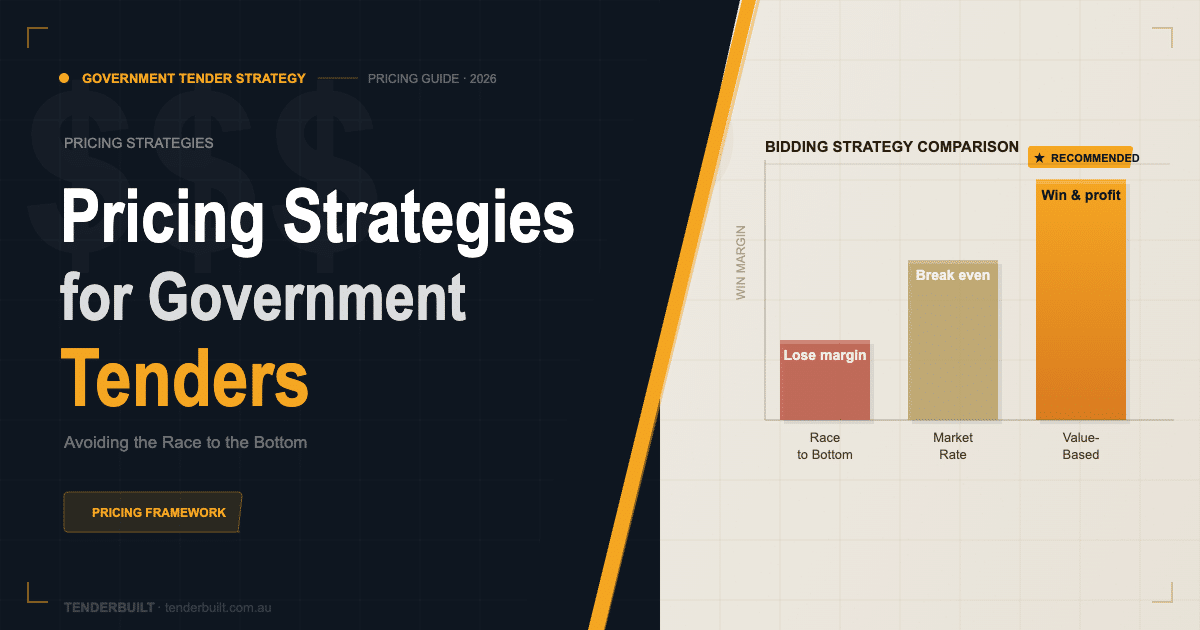
For a civil construction SME bidding on government work in the $50K–$2M range, pricing is the difference between profitable growth and joining that statistic. The good news is that Australian government procurement is not actually a lowest-price game. Every state and Commonwealth procurement framework defines value for money — not lowest price — as the primary consideration in awarding contracts.[3] The bad news is that many SMEs price as though it were a lowest-price game, and discount their margins until they are bidding work that bankrupts them whether they win or lose.
This guide is about pricing tenders to win profitable, deliverable contracts — and avoiding the discount-led death spiral that has consumed thousands of Australian construction SMEs in the past three years. It pairs with our companion guides on how government tenders are scored and when to hire a tender writer versus DIY.
In This Guide
- The race to the bottom — what it actually costs the industry
- Value for money — the legal definition every SME should know
- What price weighting actually looks like in Australian tenders
- Margin benchmarks for civil construction tenders
- Six pricing strategies that win without racing to the bottom
- Pricing risk — the costs evaluators do not see
- Variation strategy and the unbalanced-bidding trap
- Justifying a higher price in your tender response
- When the disciplined answer is no-bid
- A pricing decision framework
1. The race to the bottom — what it actually costs the industry
The economics of Australian construction in 2024–2026 make the case against aggressive discount pricing better than any opinion piece could. Three data points frame the crisis:
- Construction insolvencies have risen for four consecutive years. ASIC records show 2,259 appointments in FY22, 2,965 in FY23 (+31%), 3,490 in FY24 (+18%), and 2,636 in the year to March 2025 (+23% YoY).[4]
- Costs and time have moved against contractors. The Productivity Commission’s 2025 report found that over the past five years construction costs have risen by 40%, while residential build times have extended by up to 80%.[5] Construction productivity is 12% lower now than 30 years ago, even after adjusting for house size and quality.
- Small businesses are the most exposed. Construction businesses with under five full-time employees continue to enter external administration at record-high levels, while mid-to-large businesses (revenue $10M+) have stabilised — Equifax data shows margins recovering across building, construction services, and civil construction sub-divisions in FY24.[6]
The cause-and-effect is straightforward. Many of the failed contractors signed fixed-price contracts in 2020–2022 at margins that assumed pre-pandemic input costs. When concrete, steel, asphalt, fuel, and labour costs rose 20–40%, those contracts became loss-making — and the loss compounded with every project still on the books. The lesson for civil construction SMEs is not “do not bid government work.” The lesson is “do not bid work at prices that cannot survive a 10–20% adverse movement in input costs over the contract duration.”
2. Value for money — the legal definition every SME should know
Australian government procurement is governed by the principle of value for money, not lowest price. This is not a soft preference — it is the explicit, mandatory primary consideration in every state and Commonwealth procurement framework.
Victoria’s Department of Treasury and Finance defines it directly: “Value for money does not necessarily mean lowest price: it means best value procurement outcomes based on a balanced judgement of financial and non-financial factors relevant to the procurement, taking into account the total benefits and costs over the life of the goods, services or works procured.”[7] The Tendering Guidelines for NSW Local Government use almost identical language, defining value for money as “a comparison of the apparent benefits in the proposed contract with the whole-of-life costs of the proposed contract or project,” with relevant factors including experience, quality, timeliness, service, risk profiles, and initial and ongoing costs.[8]
Queensland’s official Price Quality Method for evaluating tenders goes further. It establishes a “quality premium” in monetary terms — a notional value assigned to each tender compared to the tender with the lowest non-price criteria score.[9] In other words, Queensland’s evaluation model explicitly recognises that a higher-priced tender with stronger non-price content can deliver better value for money than a lower-priced tender with weaker content.
What this means in practice for a civil construction SME: your job in pricing is not to be the cheapest. Your job is to be the best value at a price that lets you deliver the work profitably. The two are not the same thing.
3. What price weighting actually looks like in Australian tenders
Most Australian government civil tenders use a weighted scoring methodology where price is one criterion among several, typically scored separately and combined for a total value-for-money score. The price weighting matters because it tells you how much room you have to compete on non-price factors.
Typical price weightings in Australian government tenders
| Tender type | Typical price weighting | Implication |
|---|---|---|
| Routine RFQs (under $250K) | 50–70% | Price-led; focus on competitive but sustainable pricing |
| Standard civil RFTs ($250K–$2M) | 30–50% | Methodology, capability, WHS, ESG carry equal or greater weight than price[10] |
| Complex infrastructure RFTs (above $2M) | 20–40% | Non-price differentiation dominates; quality premium is significant |
| Local government tenders (general) | 40% (price) / 60% (non-price) common | Local content, social procurement, prior performance carry heavy weight[11] |
Indicative price weightings across Australian government tender categories. Always check the specific RFT — weightings vary materially by agency.
How price scoring usually works
The dominant scoring methodology for price in Australian tenders is the lowest-price-equals-highest-score method: the lowest tendered price receives the maximum price score (usually 10), and other tenders are ranked proportionally — so a tender priced 10% above the lowest receives roughly 10% less than the maximum price score.[12]
Run the maths on a typical civil RFT with a 40% price weighting and a 60% non-price weighting. Tenderer A submits at $500,000 with a methodology that scores 6/10. Tenderer B submits at $550,000 (10% higher) with a methodology that scores 9/10. On price, A scores 10 × 40% = 4.0; B scores 9 × 40% = 3.6. On non-price, A scores 6 × 60% = 3.6; B scores 9 × 60% = 5.4. Total: A = 7.6, B = 9.0. Tenderer B wins by a comfortable margin despite being 10% more expensive, because the non-price differential outweighs the price differential.
This is the maths that should govern every pricing decision a civil SME makes. The room to price for sustainable margin exists in almost every Australian government tender — but only if your non-price content is strong enough to absorb the price gap.
4. Margin benchmarks for civil construction tenders
The realistic margin envelope for Australian government civil tenders is well-established. The Tender Team’s published guidance places government tender margins at 8–15%, materially lower than private-sector work, with the lower end driven by higher compliance and reporting overheads associated with government contracting.[13] Industry benchmarks for SME civil contractors typically place sustainable net margins for government work in the same band.
Indicative margin structure for a $500K civil RFT
| Cost category | Typical % of total | Notes for civil construction |
|---|---|---|
| Direct labour (own + subcontractors) | 30–45% | Wage indexation and labour shortage premiums apply |
| Plant and equipment (owned + hired) | 15–25% | Fuel, hire rates, maintenance, depreciation |
| Materials (concrete, asphalt, aggregate, drainage) | 15–30% | Volatile through 2022–2025; conditional on lock-ins from suppliers |
| Site overheads (supervision, site office, services) | 5–10% | Often under-priced by SMEs |
| Head office overhead | 6–10% | Estimating, admin, finance, marketing, owner time |
| Contingency / risk allowance | 3–8% | Should be calibrated to specific site risk |
| Margin / profit | 8–15% | Government work typically lower than private[14] |
Indicative margin structure for an Australian civil construction government RFT in the $50K–$2M range. Actual percentages vary materially by work type, location, and competitive intensity.
Two warnings flow from these benchmarks. First, an SME tendering at less than 8% margin on government work has effectively zero buffer for adverse cost movement, programme overruns, or delivery surprises — a single bad month on a project at that margin can wipe out the whole profit. Second, an SME bidding work at zero or negative margin to “keep the team busy” is following the exact playbook that consumed Porter Davis Homes, Lloyd Group, and 9,000+ other Australian construction businesses since 2022.[15]
5. Six pricing strategies that win without racing to the bottom
Strategy 1 — Price to your cost base, not to the market
The cheapest-tenderer-wins mindset assumes your job is to guess the market clearing price. The disciplined alternative is to build your price up from your actual cost base — labour, plant, materials, overheads — apply your sustainable margin, and submit. If your price is higher than the market, the answer is rarely “cut margin.” It is “either we are uncompetitive in this work category and should not be bidding, or our cost base is too high and needs structural attention.”
Strategy 2 — Sell value, not units
Most civil RFTs allow tenderers to articulate value beyond the bare scope of works. Programme certainty (early completion bonuses, weather-resilient methodology), risk transfer (assumption of geotechnical risk, contamination risk, weather risk), local content (local supplier panels, regional employment), and post-completion support (defect liability discipline, asset handover) can all be priced into the bid and explained in the tender narrative. The Tender Team observes that on construction projects, value can be demonstrated through whole-of-life cost framings — a higher tendered price that delivers lower total cost over the contract period.[16]
Strategy 3 — Differentiate by methodology quality, not price
The pricing maths in Section 3 demonstrates that a 10% price premium can be more than offset by a 3-point methodology score uplift. Investment in a superior methodology document — site-specific, sequenced, evidence-backed — is almost always a higher-leverage use of bid resource than chasing a 5% price reduction. See how to write a winning tender for earthworks projects for the tactical detail.
Strategy 4 — Win at the right price band
Australian SMEs win disproportionately at specific contract value bands. In NSW in 2024, over 1,500 contracts valued between $150,000 and $250,000 went to SMEs — approximately 51% of contracts in that band.[17] This is the band where Tier 1 and Tier 2 contractors do not bid (too small), where direct procurement provisions favour SMEs (NSW raised the SME direct threshold to $250,000 in November 2023), and where the competitive set is thinnest. Concentrating bid effort in your sweet-spot band is a price strategy in itself: the same margin generates a higher win rate than chasing larger work where you compete head-to-head with bigger players.
Strategy 5 — Use provisional sums and exclusions rigorously
Many civil tenders allow provisional sums for items that cannot be priced with certainty — rock excavation, contaminated soil disposal, dewatering, unforeseen services. Pricing these conservatively in the base bid risks losing the tender; pricing them aggressively risks losing your shirt on delivery. The disciplined alternative is to use provisional sums where the RFT permits, list explicit exclusions where it does not, and document assumptions in a separate departures schedule. Evaluators read assumptions and exclusions carefully — and they would rather award to a tenderer who has been transparent about risk than one who has hidden it in price.
Strategy 6 — Build pricing intelligence from debriefs
Every formal debrief from a lost tender that includes the price gap to the winner is data. Over time, that data builds a pricing intelligence model: how much above the median wins, how much above the lowest loses, by client and work type. Most SMEs do not request debriefs systematically — and consequently price every bid from intuition rather than evidence. See our companion piece on building a tender content library for how to capture debrief data in a way that compounds over time.
6. Pricing risk — the costs evaluators do not see
Government tendering carries a set of compliance and reporting overhead costs that private-sector work does not, and that many SMEs systematically under-price. The Tender Team observes that the level of compliance and communication associated with a small public toilet block contract for a local council is significantly higher than building a residential home in Sydney, even though the contract value is a fraction of the size.[18]
The compliance cost stack
Costs you should explicitly load into your pricing model:
- Pre-construction documentation — Construction Phase Plan, Site Establishment Plan, ESCP finalisation, Traffic Management Plan, WHS Management Plan adapted to site, ITPs, SWMS for every high-risk activity. Typically 40–80 hours of senior staff time before a sod is turned.
- Reporting cadence — monthly progress reports, weekly site meeting attendance, quarterly social procurement reporting, monthly insurance currency confirmations, payment claim documentation under the Security of Payment Act.
- Audit and inspection regime — agency-mandated quality audits, WHS audits, social procurement audits (NSW APP audits 5% of contracts annually[19]), as-built survey delivery in agency-specified formats.
- Variation administration — government variations carry heavier evidentiary requirements than private work; latency between submission and approval is typically 30–60 days, creating cash-flow drag.
- Defect liability period reporting — typically 12 months post-PC, with quarterly inspections and monthly defect closure reporting on agency systems.
- Retention release — typically 5% of contract value held for 12 months post-PC; cash-flow cost should be priced in.
For a $500,000 civil RFT, these compliance costs commonly add up to $25,000–$45,000 — between 5% and 9% of contract value. SMEs who are not already absorbing these costs in head office overhead end up financing them out of margin, which is precisely what wipes out the 8–15% profit envelope.
7. Variation strategy and the unbalanced-bidding trap
Some SMEs respond to tight margins by pricing the base bid low and planning to recover margin through variations. This is technically known as unbalanced bidding, and it is one of the most consistent destroyers of contractor profitability and reputation in government procurement.
Three reasons it does not work:
- Government clients have tight variation discipline. Every variation must be technically justified, agency-approved, and tied to a documented scope change. Variations driven by base-scope items the contractor “missed” are rejected. Latency between submission and approval is typically 30–60 days.
- Aggressive variation behaviour kills future work. Government clients track contractor behaviour. A pattern of high variation values relative to base bid will reduce evaluation scores for past performance on future tenders — and past performance is increasingly an explicit, weighted criterion under Victorian and NSW procurement frameworks.[20]
- The cash-flow drag is brutal. Variations approved at month four are typically paid at month six. A contractor relying on variation income for margin operates with a 60–90 day funding gap on disputed amounts, against a backdrop of construction’s already lengthy payment cycles.[21]
The disciplined alternative is to price the base bid honestly, document every assumption, request clarification on ambiguous scope before submission, and quote variations only for genuine scope changes — not for items that should have been in the original bid.
8. Justifying a higher price in your tender response
If your price is above the lowest in the field, the tender response itself is your tool to convert the price gap into a value-for-money advantage. Specific techniques that work:
- Price-justification narrative within the methodology. One paragraph in the executive summary explaining what your pricing includes that competitors may have excluded — for example, comprehensive insurance overlays, dedicated supervision, programme float, weather contingency, post-completion warranty.
- Whole-of-life cost framing. For projects with long-tail consequences (durability of materials, ongoing maintenance liabilities), explicitly frame your price in whole-of-life rather than capital terms. Most evaluation panels will discount upfront price differences if whole-of-life cost is materially lower.
- Risk transfer pricing. Where you have priced in retained risk that competitors have left to the principal (geotechnical risk, weather risk, latent conditions), make this explicit. The principal is paying real money to avoid those risks landing back on them mid-project.
- Quality premium evidence. Past project data — completion ahead of programme, defect-free handover, KPI scoring on prior agency work — quantitatively supports a price premium. Vague claims do not.
- Exclusion transparency. Listing what is not in your price (with justification) is more credible than appearing to have included everything at an impossibly low number. Evaluators respect transparency.
9. When the disciplined answer is no-bid
The hardest pricing decision is the decision not to bid. Industry research consistently finds that high-performing tender teams submit fewer, better-qualified responses rather than chasing volume.[22] The pricing-related no-bid triggers are specific:
- The competitive set is too crowded. If 12+ bidders are expected on a $300,000 RFT, the lowest-price scoring methodology will likely award below your sustainable margin. Pass.
- The work is being baited by a Tier 1 or Tier 2 contractor. Some prime contractors price aggressively on smaller jobs to lock-in a panel position or maintain crew utilisation. SMEs cannot win against this commercial logic. Pass.
- The scope is genuinely ambiguous. If the RFT contains scope elements that cannot be priced with reasonable confidence, and the agency has refused clarification, the risk loading required to price safely will make you uncompetitive. Pass.
- Your cost base is uncompetitive in this work type. If your direct cost build-up is materially above what you know to be the market clearing range for this work, the gap will not close through better bid writing. Pass and reconfigure your cost base.
- The contract conditions transfer unbearable risk. Some government contracts contain clauses (uncapped liquidated damages, broad indemnities, latent condition risk transfer) that fundamentally change the economic profile of the work. Read the conditions before pricing — not after.
A disciplined no-bid is a pricing decision. It is the decision not to price loss-making work just because the opportunity exists.
10. A pricing decision framework
Apply this five-step framework to every government RFT in the $50K–$2M range:
- Run the bid/no-bid first. Score the opportunity on strategic fit, win probability, profitability, and capacity. Below threshold → no-bid. Above threshold → proceed.
- Build price from cost base, not from market guess. Direct labour + plant + materials + site overheads + head office overhead + risk contingency + sustainable margin (8–15%). Do not start by guessing what will win.
- Identify your non-price differentiation. What in your methodology, capability, WHS, ESG, or local content positions you to score 7–9 on non-price criteria? If the answer is “nothing distinctive,” you are in a price-only contest you probably will not win profitably.
- Run the price-vs-non-price maths. Estimate where your bid will land on price relative to expected competitors, and what non-price score you can credibly target. Calculate total weighted score. If it does not exceed expected competitor scores, you have three choices: improve non-price content, restructure scope/exclusions, or no-bid.
- Document your assumptions and exclusions transparently. Submit a clean base bid with explicit departures schedule. Avoid unbalanced bidding and aggressive variation strategies that destroy past-performance scores on future tenders.
The pricing self-test. Before submitting any tender, ask: “If I win this contract at this price, and input costs move 10% against me over the contract duration, can I still deliver to specification without going broke?” If the answer is no, the price is wrong. The construction insolvency wave of 2022–2025 is a graveyard of contractors who answered yes to the same question and were wrong. Better to lose a tender at a profitable price than win it at a loss-making one.
The race-to-the-bottom dynamic in Australian construction is real, and it is killing businesses at a rate the industry has not seen in decades. The good news for civil construction SMEs is that government procurement frameworks are explicitly designed to reward value over price, and the maths consistently demonstrates that a credible non-price premium more than compensates for a sustainable price premium. Pricing discipline — anchored in your actual cost base, calibrated to your sweet-spot work band, supported by methodology and evidence that justifies your number — is the difference between profitable growth and joining the ASIC statistics. The market does not need more cheap contractors. It needs more profitable ones.
References
- Forward Path Advisory, Building Company Insolvencies in Australia (May 2023 to May 2025) — forwardpathadvisory.com.au/building-company-insolvencies. ASIC data: 2,636 construction insolvencies in year to March 2025; ~27% of national company failures. ↩
- Accounting Times, Construction and Hospitality Insolvencies Continue to Climb: ASIC — accountingtimes.com.au/asic-construction-insolvency. Many businesses burdened with legacy debt from fixed-price contracts. ↩
- Victorian Department of Treasury and Finance, Evaluation Criteria (Public Construction — Direction and Instruction 3.7) — dtf.vic.gov.au/evaluation-criteria-direction-37. Value for money must be the primary determinant of the procurement outcome. ↩
- Forward Path Advisory, op. cit. ASIC FY22–FY25 construction insolvency progression. ↩
- Productivity Commission via CRC Project #80, Why Are Insolvencies So High in the Residential Construction Industry? — building4pointzero.org/CRC80-report (PDF). Construction costs up 40% over five years; build times extended up to 80%; productivity 12% lower over 30 years. ↩
- Equifax, Construction Insolvency Trends and Financial Health of Construction Businesses — equifax.com.au/construction-insolvency-trends. Margins recovering for businesses with revenue over $10M; small businesses (under 5 FTE) continue elevated failure rates. ↩
- Victorian DTF, Evaluation Criteria (Public Construction — Guidance 3.7) — dtf.vic.gov.au/evaluation-criteria-guidance-37. Value for money definition. ↩
- Local Government Procurement, Are You Truly Evaluating Value for Money? — lgp.org.au/value-for-money. NSW Local Government Tendering Guidelines definition. ↩
- Queensland Government, Guide Note: Price Quality Method for Evaluating Tenders — forgov.qld.gov.au/price-quality-method (PDF). Quality premium methodology in monetary terms. ↩
- Kubri / KPMC, Guide to the Construction Tendering Process in Australia — kubri.com.au/construction-tendering-process. Government agencies commonly apply 60% non-price weighting covering methodology, capability, safety, and ESG criteria. ↩
- Local Government Procurement, op. cit. NSW councils commonly use 60% non-price / 40% price weighting. ↩
- Mastt, Tender Evaluation in Construction: Process, Scoring, & Compliance — mastt.com/guide/tender-evaluation. Lowest-bid-equals-10 price scoring methodology. ↩
- The Tender Team, Strategic Pricing for Tenders — thetenderteam.com.au/pricing-strategy. Government margins typically 8–15%, lower than private sector. ↩
- The Tender Team, op. cit. Government work margin band. ↩
- Forward Path Advisory, op. cit. Cumulative construction insolvencies 2022–2025; Porter Davis Homes, Lloyd Group examples. ↩
- The Tender Team, op. cit. Whole-of-life cost framing as a price-justification mechanism. ↩
- Procurement and Supply Australasia, NSW Government Records $10B SME Spend Following Procurement Reforms — procurementandsupply.com/nsw-sme-spend. Over 1,500 contracts $150K–$250K to SMEs in 2024 (~51%). ↩
- The Tender Team, op. cit. Public toilet block versus residential home compliance comparison. ↩
- NSW Aboriginal Procurement Policy, audit provisions; NSW APP Section 6 — Monitoring and Compliance. See info.buy.nsw.gov.au/aboriginal-procurement-policy. ↩
- Victorian DTF Direction and Instruction 3.7, op. cit. Past performance as mandatory evaluation criterion. ↩
- Worrells, Insolvency in the Construction Sector — worrells.net.au/construction-insolvency-red-flags. Construction industry wafer-thin margins and lengthy payment cycles. ↩
- SparrowGenie, Tender Bidding: Key Steps, Process & Best Practices (2026) — sparrowgenie.com/tender-bidding. Top performers submit fewer, better-qualified responses. ↩
Want help pricing your next tender to win profitable work?
TenderBuilt helps civil construction SMEs structure pricing strategy, justify value-based pricing in tender responses, and run disciplined bid/no-bid qualification — so you win work that actually pays.Get a Free Quote