
In short
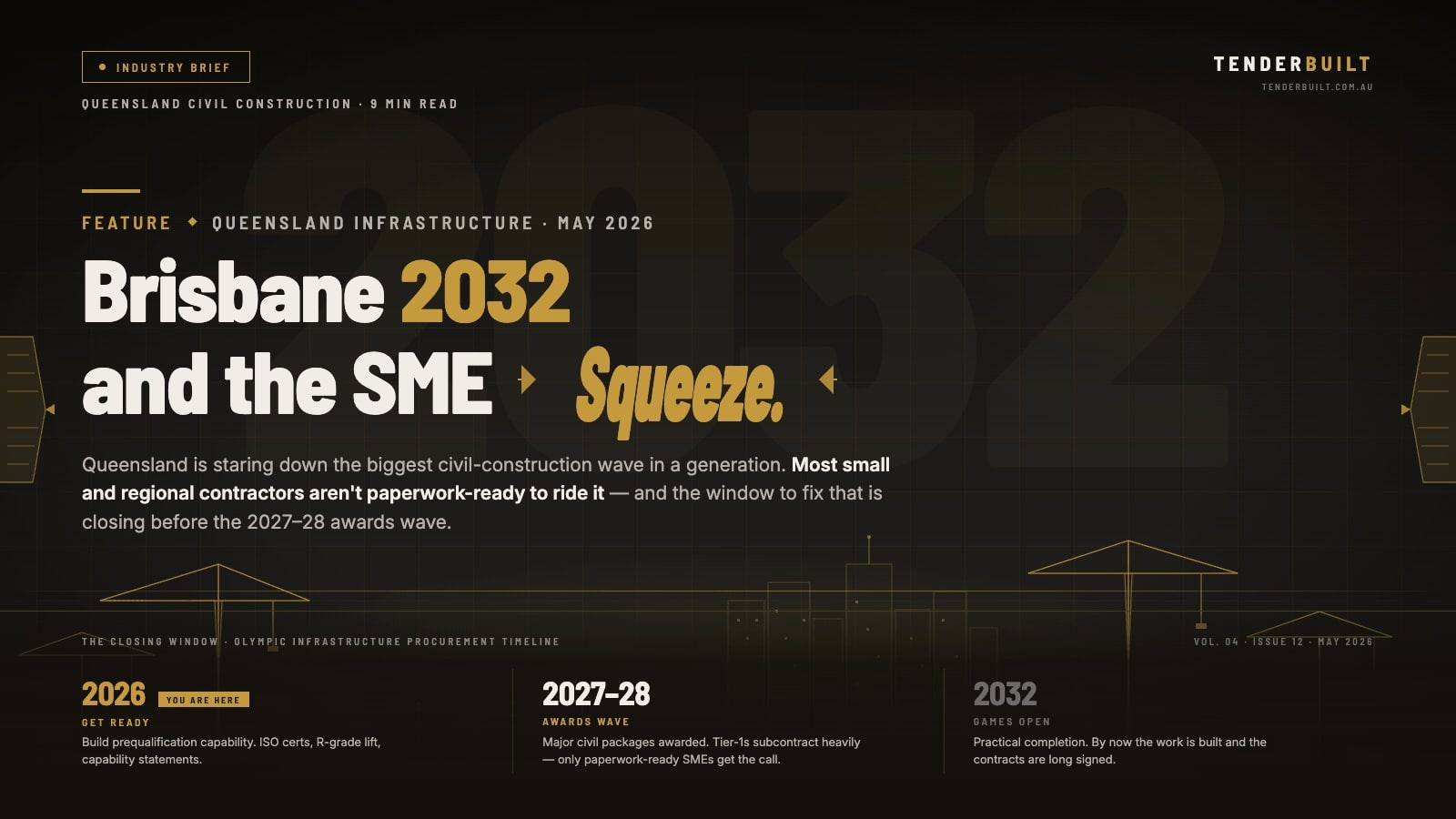
Queensland’s civil pipeline is the largest ever, a $119.2 billion four-year capital program and a $55.9 billion roads program, but almost all of it reaches SMEs as Tier 1 subcontract packages gated by PQC, TMR prequalification and ISO certification. The awards wave compresses into 2027-28, so be prequalified, certified and visible by the end of 2026.
The numbers are extraordinary. The Queensland Major Contractors Association’s 2025 pipeline report puts the state’s engineering-construction pipeline at a record $127.5 billion over five years — a 22.7% jump on the year before.[1] The 2026–27 State Budget committed a record $119.2 billion four-year capital program to 2029–30, $29.6 billion of it in 2026–27.[2] Sitting inside that is a $7.1 billion Brisbane 2032 venues envelope,[3] a $55.9 billion four-year roads program (QTRIP 2026–27 to 2029–30),[4] and a $9 billion Bruce Highway safety program where every dollar is spent between Gympie and Cairns.[5]
The Civil Contractors Federation Queensland summed up the moment better than anyone. Its chief executive has warned the industry’s coming test won’t be that times are tough — but that they will be “almost too plentiful.”[6] The catch buried in that abundance: the machinery that hands out this work is built around prequalification gates, financial thresholds, certification requirements and Tier 1-led panels that quietly exclude most SMEs from prime contracts. The bottleneck for a capable regional contractor is rarely the dirt. It’s the paperwork — and the paperwork takes months.
This briefing maps the pipeline, explains the gates, and sets out a practical, evergreen checklist of what a civil construction SME must do now to be prequalification-ready before contracts start landing in earnest. If you haven’t already, pair it with our pillar guide on how to write a winning civil construction tender and our civil contractor prequalification guide.
1. The biggest civil wave in 20 years
Strip away the Olympic headlines and the underlying picture is still the largest civil pipeline Queensland has ever assembled. The Queensland Audit Office reported that the total estimated cost of projects in the state’s capital statement rose from $107 billion to $153 billion in a single year.[7] QMCA’s pipeline report states the industry must now deliver a minimum of $14.5–15 billion of work every year just to keep pace.[1]
The Olympic component is real but smaller than the noise suggests. The legislated venues envelope is $7.1 billion, split roughly evenly between the Commonwealth and Queensland, to deliver 17 new and upgraded venues — anchored by a new 63,000-seat stadium at Victoria Park estimated at $3.785 billion (early works began in June 2026 once the land passed to GIICA), plus the National Aquatic Centre, Sunshine Coast Stadium, Cairns’ Barlow Park, and indoor sports centres at Logan and Moreton Bay.[3][8] Property analysts at CBRE estimate Olympic-related construction will total around $11 billion between late 2026 and mid-2031.[9]
But for a civil SME, the bigger prize is the work surrounding the Games rather than the venues themselves: athlete villages on the Gold Coast, Sunshine Coast and Brisbane; transport enabling works like Coomera Connector and Gold Coast faster rail; and — most accessibly — the $9 billion Bruce Highway Targeted Safety Program, which released 22 new contracts in December 2025 and is rolling out designer and constructor panels along the Gympie-to-Cairns corridor.[5] The roads program (QTRIP) alone allocates roughly $21 billion outside Brisbane in regional Queensland.[4]
The headline figures, untangled. “Brisbane 2032” is often used loosely. Be precise about which number you’re quoting: the $7.1B venues envelope (17 venues only); ~$11B total Olympic-related construction (CBRE estimate, 2026–2031); the $55.9B four-year QTRIP roads program; and the $127.5B five-year QMCA engineering pipeline. They measure different things — and conflating them is the fastest way to lose credibility with a procurement team.
2. Why a record pipeline is a lockout risk for SMEs
A bigger pipeline does not automatically mean more accessible work. In several respects it means the opposite. Here is how the squeeze works in practice.
Work is bundled into packages too big for an SME to lead
The entire $7.1 billion venues program is being program-managed by a single delivery partner — Unite32, a joint venture of AECOM and Laing O’Rourke, appointed in December 2025.[10] The $3.785 billion Brisbane Stadium is being contested by multinational consortia.[8] The Bruce Highway program runs through dedicated panels.[5] The practical result is that an SME bidding $50K–$2M packages will almost never hold a direct head contract on this work — they reach it as a subcontractor to a Tier 1, or not at all.[11]
Financial thresholds scale faster than an SME’s balance sheet
Queensland’s prequalification systems tie the size of work you can bid to the size of your balance sheet. As we’ll see below, a contractor with around $340,000 in net tangible assets is capped at roughly a $2.7 million annualised contract value under the state’s PQC rules.[12] Every step up to larger packages demands proportionally more audited capital, insurance and bonding — and each step is a fresh assessment, not an automatic upgrade.
The bid itself is expensive and document-heavy
A major civil tender pack can run past a thousand pages of mandatory schedules: ISO certificates, a Buy Queensland statement, purposeful public procurement responses, training and workforce plans, environmental and safety management plans, RPEQ-certified design responses and detailed price schedules. Preparing a single major bid can cost tens of thousands of dollars before a contractor has won a cent — a sunk cost that favours firms with dedicated bid teams. (Our guide to how government tenders are scored breaks down where those marks are won and lost.)
A labour shortage means Tier 1s get first pick
Construction Skills Queensland’s Horizon 2032 work forecasts workforce demand peaking around 156,000 workers in 2026–27, with a sustained shortfall.[13] QMCA’s pipeline report puts the shortage at more than 41,600 workers and documents a near-60% collapse in output per construction worker since 2000, warning of a “perfect storm of cost escalation and productivity decline.”[14] When skilled labour is scarce, the biggest contractors absorb it first — squeezing the subcontractors below them.
The honest counter-point. None of this means SMEs are shut out by design. Government policy actively wants local and small-business participation — Queensland retains a 30% SME procurement spend target,[15] and the Brisbane 2032 organising committee reports 44% of its current supplier spend already flows to SMEs.[16] But that 44% figure is a snapshot of current spend, not a binding forward quota for the infrastructure program — and the doors it describes only open to firms that are already prequalified and visible. Policy intent doesn’t prequalify you. You do.
3. The machinery that controls the money
To position for this work you need to know who is actually buying it. Four bodies matter most.
GIICA — the Olympic venues authority
The Games Independent Infrastructure and Coordination Authority (GIICA) was established as an independent statutory authority in November 2024 to deliver the 17 venues.[17] Its 100-Day Review produced 86 recommendations, more than 90% accepted, and reinstated the Victoria Park stadium plan.[18] GIICA runs its procurement through the VendorPanel platform and releases tenders via QTenders, and it has appointed Unite32 (AECOM + Laing O’Rourke) as its delivery partner for the entire venues program.[17][10] By 2026 it has moved, in its CEO’s words, into delivery mode.[19]
Transport and Main Roads — the roads buyer
TMR owns the $55.9 billion QTRIP roads program, the Bruce Highway panels, and the prequalification regime that gates almost all state road and bridge work.[4][20] For most civil SMEs — earthworks, drainage, sealed roads, asphalt, small bridges — TMR is the single most important relationship to build.
Queensland Procurement Policy 2026 and Buy Queensland
The whole-of-government Queensland Procurement Policy applies to GIICA, the villages program and the organising committee alike. For “significant procurement” at or above $500,000, agencies must apply a purposeful-public-procurement criterion carrying a total evaluation weighting of 10–20%, covering local benefit, social and economic outcomes.[21] QPP 2026 also moved the local definition: the retired Local Benefits Test measured a local workforce within 125 km of the project, whereas the 2026 policy defines a local workforce as residing within 250 km of the supplier’s place of business — a definition that, read correctly, still favours regional contractors on regional projects.[21] Our dedicated QPP 2026 explainer and our social and Indigenous procurement guide cover how to convert that weighting into marks.
The organising committee’s separate procurement stream
Distinct from infrastructure, the Brisbane 2032 organising committee runs roughly $2.5 billion of non-infrastructure procurement across about 500 packages — temporary works, transport, fencing, signage, technology and event services — routed through the Gateway by ICN supplier portal.[22] Some of this is genuinely accessible to smaller civil and trades firms.
4. Gate one — Queensland’s PQC system
The Prequalification (Construction) system, or PQC, is administered by the Department of Housing and Public Works and is mandatory for state government building projects above $1 million.[23] To register at all, a contractor needs minimum net tangible assets for government (NTA-Govt) of $156,000, a current ratio of at least 1:1, and a minimum of $20 million in public liability insurance.[24]
The system sorts contractors into financial categories, each linking the capital you hold to the revenue and contract value you’re allowed to carry:[12]
| PQC category | NTA-Govt required | Max Revenue-Govt |
|---|---|---|
| Category 1 | $46,001 – $156,000 | $800,001 – $3,000,000 |
| Category 2 | $156,001 – $480,000 | $3,000,001 – $12,000,000 |
| Category 3 | $480,001 – $1,200,000 | $12,000,001 – $30,000,000 |
| Category 4 | $1,200,001 – $2,400,000 | $30,000,001 – $60,000,000 |
| Category 5+ | $2,400,001 and above | $60,000,001 and above |
Source: Department of Housing and Public Works, PQC Contractor Financial Requirements Guideline. NTA × 16.67 sets Max Revenue-Govt.
The catch that surprises most contractors is the One-Third Rule. Your maximum annualised contract value is capped at one-third of your Max Revenue-Govt. The department’s own worked example: a contractor with $340,000 in NTA-Govt qualifies for around $8.1 million in Max Revenue-Govt, but is limited to government projects of about $2.7 million — one-third of that figure.[12] In other words, every dollar of net tangible assets you hold unlocks roughly five dollars of annualised contract capacity. Thin capital is a hard ceiling.
Processing is faster than it once was — the department has aimed to assess new applications within about four weeks since rolling out a smart form, though it publishes no guaranteed turnaround, so treat four weeks as a best case and allow longer to assemble audited financials.[25]
5. Gate two — TMR and the National Prequalification System
For road and bridge work, the relevant regime is TMR’s prequalification, which sits under the national framework administered through Austroads.[20] It classifies contractors across three axes: roadworks (R1 to R5), bridgeworks (B1 to B4), and financial level, with separate specialist asphalt categories.[26]
The financial levels map directly to the maximum contract value you can hold, GST inclusive: F1 ($1M), F2 ($2M), F5 ($5M), F10 ($10M), F25 ($25M), F50 ($50M), and so on up to F150 PLUS (unlimited).[27] Financial gates include a quick ratio of at least 0.8, a debt-to-equity benchmark around 60/40, and three years of audited accounts.[28] TMR also runs a fresh financial review before any contract award, so prequalification is a licence to bid, not a guarantee.
TMR’s published contractor list shows the ladder clearly. Smaller specialists sit at R1–R2 / B1 with financial levels from F10 to F75; established Queensland mid-tier firms hold R3–R4 / B2–B3 at F50–F150; and the Tier 1s — Acciona, Fulton Hogan, McConnell Dowell, Downer, Decmil — sit at R5 / B4 / F150 PLUS.[29] For an SME chasing $50K–$2M packages, an entry classification of R1 or R2, B1, at F2 or F5 is the realistic and achievable target.
Higher levels also require named key personnel — for example a professional civil engineer with several years of relevant road or bridge experience, or a project manager with a decade of it — so workforce credentials, not just balance-sheet strength, gate the upper rungs.[30] Allow eight to twelve weeks for assessment, plus several months beforehand to assemble accounts, CVs, certifications and comparable project evidence.
6. Gate three — the ISO certification slow burn
The gate SMEs most often underestimate is certification. At higher prequalification levels and on most Tier 1 subcontract packages, you will be expected to hold JAS-ANZ-accredited certification to ISO 9001 (quality), ISO 45001 (work health and safety) and increasingly ISO 14001 (environmental), or an audited equivalent.[28] Our ISO certification guide for civil contractors walks through what each standard demands.
Costs for a small civil firm are manageable but not trivial. ISO 45001 alone typically runs $6,000–$15,000 for a small, low-risk business once you include the management-system build and the two-stage audit.[31] An integrated system covering all three standards usually costs $25,000–$45,000, but an integrated audit is materially cheaper than three separate ones.[32]
The bigger constraint is time. A realistic timeline from a standing start — building the system, running it long enough to generate records, then passing Stage 1 and Stage 2 audits — is around six months, with annual surveillance audits and three-yearly recertification thereafter.[31] A contractor that isn’t certified, or at least in active implementation, by late 2026 will simply be passed over when Tier 1s allocate subcontract packages through 2027–28.
7. The 10-step readiness checklist (do this now)
Here is the practical sequence. Read it with a calendar open: a contractor starting in the second half of 2026 is already tight for the 2027–28 awards wave, and one starting in 2027 has very likely missed it.
1 Get PQC-registered
Lead time: 8–12 weeks · Cost: financial-assessment fees + audit prep
Apply through the Supplier Portal. Confirm you clear the minimums — $156,000 NTA-Govt, current ratio 1:1, $20M public liability — and engage a PQC-approved financial assessor early. The smart-form application is the fastest path. Re-prequalify annually.[24]
2 Get TMR / NPS prequalified at the right level
Lead time: 8–12 weeks assessment + 3–6 months preparation
Target R1–R2, B1, at F2–F5 for $50K–$2M earthworks, drainage and sealed-road subcontract packages. Assemble three years of audited accounts, key-personnel CVs, ISO certificates and evidence of comparable past projects before you apply.[27]
3 Achieve ISO certification — or be visibly mid-implementation
Lead time: ~6 months · Cost: ~$15K (45001) to $25K–$45K (integrated)
Build an integrated 9001 / 14001 / 45001 system — the integrated audit is cheaper than three separate ones. If full certification isn’t achievable before a bid, demonstrable active implementation with a documented system is the minimum credible position.[32]
4 Build a tender content library and capability statement
Lead time: ongoing · Cost: internal time
Pre-write the assets you’ll reuse on every bid: company overview, personnel CVs with RPEQ numbers, plant registers, methodology templates for earthworks/drainage/asphalt/concrete, management-plan templates, case studies and current insurance certificates. Our capability statement framework and tender content library guide show how to structure both.
5 Register on every relevant portal
Lead time: days · Cost: free
Create supplier profiles on QTenders, VendorPanel (GIICA’s venue platform), Gateway by ICN (the Brisbane 2032 supplier portal), and your local council tender alerts — Sunshine Coast, Cairns, Logan, Moreton Bay, Toowoomba and Rockhampton all have venue co-host roles.[33] If you’re chasing road work, get onto the relevant TMR Bruce Highway panels.
6 Position deliberately for Tier 1 / Tier 2 subcontracting
Lead time: ongoing relationship-building
Identify which majors are winning packages near you — Unite32 across the venues program; the consortia competing for Brisbane Stadium; Fulton Hogan, McConnell Dowell, Downer and Queensland mid-tiers on roads. Approach them with specific, package-aligned offers, not a generic capability statement.[11]
7 Build a purposeful public procurement response capability
Lead time: ongoing · worth 10–20% of evaluation
Document your local-workforce residency (within 250 km of your place of business under QPP 2026), apprentice and trainee numbers, local subcontractor and supplier engagement, and Indigenous-business engagement. On regional projects this weighting is an SME advantage — if you can evidence it.[21]
8 Form consortia or joint ventures to reach bigger scopes
Lead time: weeks to months
Partner with complementary specialists and design or project-management firms to nominate for partial-scope opportunities — Gateway by ICN allows partial nominations. Note that unincorporated joint ventures are usually granted only conditional prequalification, so structure deliberately.[34]
9 Strengthen the balance sheet before you bid
Lead time: a full financial year
Refresh audited accounts annually, keep your current ratio above 1.0 and your quick ratio above 0.8, and arrange a bonding or surety facility ahead of need. Because of the One-Third Rule, lifting NTA is the most direct lever for raising the contract size you can bid.[12]
10 Diary the awards wave and work backwards
Lead time: now
Map the dates in Section 9 against your own readiness milestones. If you aren’t prequalified and visible on the supplier portals by the end of 2026, you risk being shut out of the entire 2027–28 wave.
8. Where does your business actually sit?
Four blunt decision thresholds to locate your firm against the gates above:
- Under $156,000 NTA-Govt? You cannot register for PQC at all. Fix the balance sheet first — through retained earnings, director loans or equity — before anything else on this list.[24]
- Targeting $50K–$2M civil packages? TMR R1/R2, B1, F2 or F5 is your realistic prequalification target, and PQC Category 2 covers your annualised capacity. Don’t over-reach for classifications your accounts won’t support.
- Not ISO certified by Q4 2026? Assume you’ll be passed over in Tier 1 subcontract allocations through the peak. Start the six-month certification clock now.
- Not on Gateway by ICN, QTenders and VendorPanel yet? You are effectively invisible to the Olympic and Big Build buying machine, regardless of how good your work is.
This is not financial or legal advice, and your accountant and a prequalification specialist should pressure-test your numbers — but the thresholds themselves are fixed published requirements, not opinion.
9. Diary the awards wave
The shape of the timeline is what makes acting now non-negotiable. Only about 3% of the 2032 Delivery Plan’s funding was provisioned for spending in 2025–26 — a planning and procurement year — which means the bulk of awards compresses into a tight 2026–28 window.[11]
| Window | What happens |
|---|---|
| Late 2025 – H1 2026 | Design-consultant tenders for venues; Victoria Park stadium early contractor involvement begins; Unite32 appointed and standing up the venues program. |
| H2 2026 | Early works tenders across Sunshine Coast Stadium, Barlow Park, Logan and Moreton Bay indoor centres, Redland Whitewater and the National Aquatic Centre. Olympic construction ramp begins. |
| 2027–2028 | Peak construction tender awards across venues, athlete villages, transport enabling works and the Bruce Highway program. The main wave. |
| 2029–2031 | Peak delivery; CBRE estimates around $11B of Olympic-related construction across this period. |
| 23 July 2032 | Opening ceremony — the immovable deadline that disciplines every date above. |
Sources: GIICA procurement milestones; CBRE; Pinsent Masons analysis of the 2025–26 Budget. Dates are indicative and subject to change.
10. What’s still uncertain
Honesty about the risks is part of the case, not a hedge against it. Three things genuinely could shift.
The plan has already changed once — sharply. The Gabba rebuild was scrapped in 2024 before the Victoria Park stadium was reinstated in 2025 after a change of government and a 100-Day Review.[18] Scope and governance can move again, and Transparency International has flagged GIICA’s pursuit of fast-track planning and procurement powers as something to watch.[35]
Costs are escalating fast. QMCA forecasts construction cost escalation cumulating to around 37% by 2029 — the highest of any major state — driven by labour shortages and locked-in wage growth.[14] Queensland is also running an $8.6 billion deficit, and the Infrastructure Association of Queensland dubbed the budget “Big Build, Big Deficit.”[36] A future government could re-cut the program.
There is no SME quota to rely on. Neither GIICA nor the organising committee has published a binding percentage target for SME, regional or local participation in the infrastructure program; the often-quoted 44% is current spend, not a forward commitment.[16] The implication is the opposite of comforting: you cannot count on a policy floor catching you. Being prequalified, certified and visible is the only thing that reliably puts you in the room.
Strip it all back and the conclusion is simple. The work is coming, it is enormous, and the firms that win their share won’t necessarily be the most capable — they’ll be the ones who did the unglamorous prequalification groundwork in 2026 while everyone else was still reading the headlines.
References
This guide is general information for Australian civil construction businesses and is not legal, financial or procurement advice. Pipeline figures, delivery timelines and procurement policy for the 2032 program are published by government and revised regularly, and inclusion in a pipeline is not a commitment to tender. Treat forward estimates as indicative and confirm against current agency material before you plan capacity or capital around them.
- Queensland Major Contractors Association, Queensland Major Projects Pipeline Report 2025 (14th edition, November 2025) — record $127.5B five-year pipeline, up 22.7%; minimum $14.5–15B annual delivery required. qmca.com.au; full report csq.org.au (PDF). ↩
- Queensland Government, State Budget 2026–27 Capital Statement (Budget Paper 3), June 2026 — $119.2B capital program over the four years to 2029–30 ($29.6B in 2026–27), superseding the $116.8B program in the 2025–26 Budget. budget.qld.gov.au; summary at iaq.com.au. ↩
- Australian Government Department of Infrastructure, A new way forward to Brisbane 2032 — $7.1B venues envelope, jointly funded Commonwealth/Queensland. infrastructure.gov.au; GIICA 100 Day Review Report, March 2025, giica.au. ↩
- Department of Transport and Main Roads, Queensland Transport and Roads Investment Program (QTRIP) 2026–27 to 2029–30 — $55.9B four-year program (the 2025–26 to 2028–29 QTRIP was $37.4B). tmr.qld.gov.au. ↩
- Queensland Government Ministerial Media Statement, Bruce Highway upgrades forge ahead as 22 new contracts hit market, December 2025 — $9B Bruce Highway Targeted Safety Program, dedicated designer and constructor panels. statements.qld.gov.au. ↩
- Civil Contractors Federation Queensland — CEO Damian Long interview, CCF QLD: reform, resilience and a road to 2032, TradeEarthmovers. tradeearthmovers.com.au. ↩
- Queensland Audit Office, Major Projects 2025 — total estimated project cost in the capital statement rose from $107B to $153B year-on-year. qao.qld.gov.au. ↩
- Australasian Leisure Management, Multinational consortia shortlisted to deliver $2.7 billion Brisbane Olympic Stadium. ausleisure.com.au; stadium design, stadiaworld.com. ↩
- CBRE research (Tom Broderick, Head of Office and Capital Markets Research), cited in Is Brisbane at risk of a post-Olympic bust? — Olympic projects ~$11B between late 2026 and mid-2031. commercialrealestate.com.au. ↩
- AECOM, AECOM named Delivery Partner for Brisbane 2032, 18 December 2025 — Unite32 JV (AECOM + Laing O’Rourke) for the $7.1B venues program. aecom.com; laingorourke.com. ↩
- Pinsent Masons, Brisbane Olympics procurement accelerates as delivery risks rise — ~3% of 2032 Delivery Plan spend provisioned for 2025–26; SME access primarily via subcontracting. pinsentmasons.com; see also scalesuite.com.au. ↩
- Department of Housing and Public Works, PQC Contractor Financial Requirements Guideline — NTA-Govt categories, NTA × 16.67 Max Revenue-Govt, and the One-Third Rule (worked example: $340K NTA → ~$2.7M max project). hpw.qld.gov.au (PDF). ↩
- Construction Skills Queensland, Horizon 2032 workforce analysis — peak demand ~156,000 workers in 2026–27 with sustained shortfall. capricorniachamber.com.au. ↩
- QMCA, Queensland Major Projects Pipeline Report 2025 — shortage of more than 41,600 workers; near-60% fall in output per worker since 2000; CEO Andrew Chapman, “perfect storm of cost escalation and productivity decline”; cumulative cost escalation ~37% by 2029. qmca.com.au (PDF). ↩
- Buy Queensland — Queensland Government retains a target of 30% of procurement spend by value with SMEs. capricorniachamber.com.au. ↩
- Brisbane 2032 Organising Committee procurement strategy launch (President Andrew Liveris), October 2025 — current supplier spend ~80% local, 44% to SMEs (a snapshot, not a forward quota). olympics.com; marketing-interactive.com. ↩
- Games Independent Infrastructure and Coordination Authority (GIICA) — governance, remit and procurement platform. giica.au/about/giica-governance; giica.au. ↩
- GIICA, 100 Day Review into Games infrastructure and planning released — 86 recommendations, >90% accepted; Victoria Park stadium reinstated. giica.au. ↩
- GIICA CEO appointment (Simon Crooks), 1 August 2025; “delivery mode” framing for 2026. statements.qld.gov.au; pinsentmasons.com. ↩
- Department of Transport and Main Roads, TIPDS Volume 3 — Prequalification System (November 2024). tmr.qld.gov.au. ↩
- Queensland Procurement Policy 2026 / Local Benefits Test — purposeful public procurement weighting of 10–20% on significant procurement (≥$500,000); “local” defined as workforce within 125 km. business.qld.gov.au; historical 30% weighting per Queensland Parliament QoN 118/2020 (PDF). ↩
- business.gov.au, Unlock Brisbane 2032 Olympic and Paralympic Games opportunities — ~$2.5B non-infrastructure procurement across ~500 packages via Gateway by ICN. business.gov.au; brisbane2032games.icn.org.au. ↩
- Business Queensland, What is the Prequalification (PQC) System? — mandatory for state building projects above $1M. business.qld.gov.au. ↩
- Business Queensland, Prequalification (PQC) checklist — minimum $156,000 NTA-Govt, current ratio 1:1, $20M public liability. business.qld.gov.au. ↩
- Australian Institute of Architects, Smart form speeds up PQC application process (reporting Department of Housing and Public Works, July 2020) — four-week assessment target; no guaranteed turnaround currently published. architecture.com.au. ↩
- Austroads, National Prequalification — Categories and Levels — roadworks R1–R5, bridgeworks B1–B4, specialist asphalt categories. austroads.gov.au. ↩
- Austroads, Financial Levels — F1 ($1M) to F150 PLUS (unlimited), GST inclusive. austroads.gov.au. ↩
- Austroads, Prequalification requirements — quick ratio ≥0.8, debt-to-equity benchmark, three years of audited accounts, ISO management-system expectations. austroads.gov.au. ↩
- Department of Transport and Main Roads, Contractor Prequalification Status (3 March 2026) — R/B/F classifications across SME, mid-tier and Tier 1 contractors. tmr.qld.gov.au (PDF). ↩
- Austroads, Bridgeworks B1 (categories and levels) — named key-personnel experience requirements. austroads.gov.au. ↩
- ISO 45001 certification cost and timeframe for small Australian businesses — ~$6,000–$15,000 all-in; ~6-month realistic timeline. Sustainable Certification, sustainablecertification.com.au; Spire Safety Consultants, spiresafety.com.au. ↩
- CertBetter, ISO certification cost analysis — integrated 9001/14001/45001 audit 35–45% cheaper than three separate audits; typical integrated system $25,000–$45,000. certbetter.com; certbetter.com (45001). ↩
- Gateway by ICN — Brisbane 2032 supplier portal and Expression of Interest registration; Sunshine Coast Council Level Up procurement guidance. brisbane2032games.icn.org.au; levelup.sunshinecoast.qld.gov.au. ↩
- Austroads, National Prequalification — mutual recognition for “Full” prequalification; unincorporated joint ventures generally Conditional only; partial-scope nomination via Gateway by ICN. austroads.gov.au. ↩
- Transparency International Australia, Brisbane 2032: Why transparency and good governance must guide Olympic infrastructure — flags fast-track planning/procurement powers as a governance risk. transparency.org.au. ↩
- Infrastructure Association of Queensland, Big Build, Big Deficit: Queensland Budget 2025–26 — record infrastructure spend against an $8.6B deficit. iaq.com.au. ↩